saved
Inference Is the Most Important Market in Software
Hraness republishes this public post from a saved copy. The post is the author’s own words.
Venture capitalist at @theoryvc Student of Startups Backer of 9 unicorns Author of https://t.co/IWw3R3RVLm Subscribe https://t.co/iDgoLXaF98
If a founder built a startup in the database market in the mid-2010s, 2% market share meant the company could IPO. No surprise the database was the most important software category in that era.
Inference is about to surpass it.
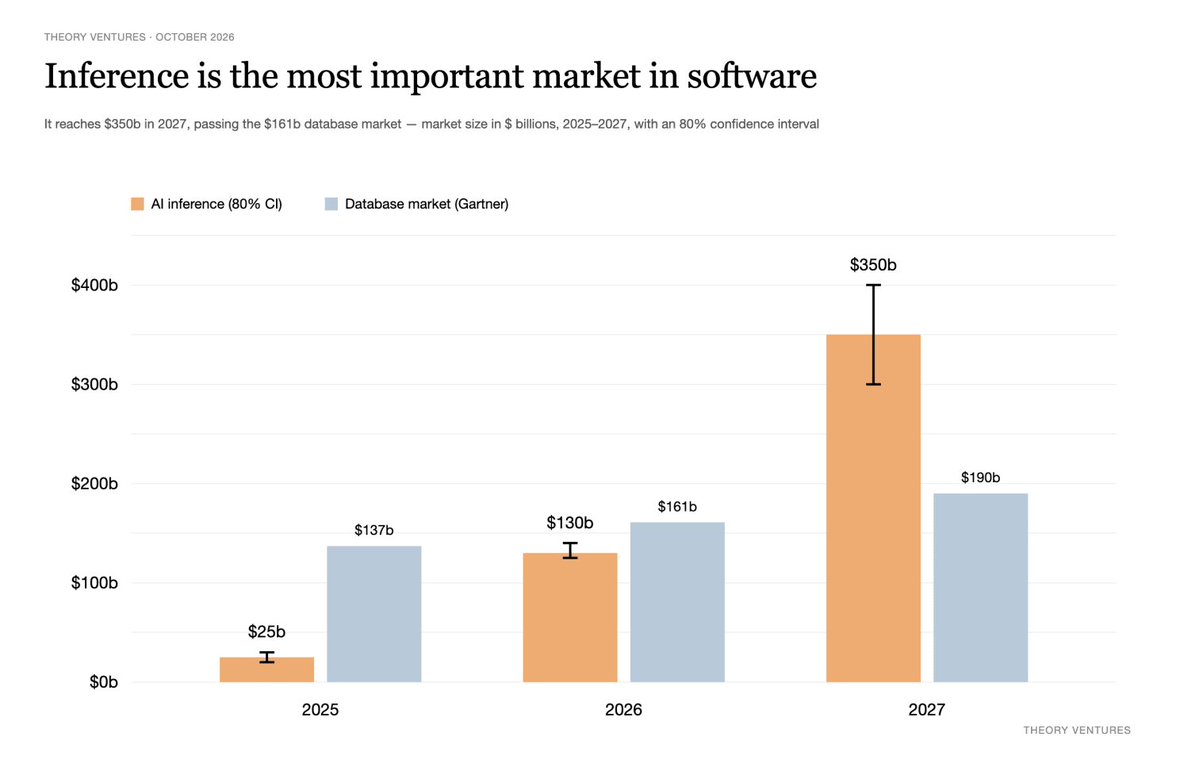
In 2025, companies paid about $25b to run AI models. This year the market reaches roughly $130b, within striking distance of Gartner’s $161b forecast for databases.1 By 2027 AI inference reaches ~$350b, passing databases ($190b) by nearly 2x.
That crossover makes inference the most important market in software: a structural transformation mutating every application into an inference reseller.
That shift rewires application/harness unit economics in three ways:
- Usage could dwarf platform fees & fuel record-setting growth. The inference consumption bill will exceed the seat license or base subscription. This changes AE compensation plans, demands predictable plans for customers who fear blown budgets, & complicates forecasting.
- Gross margins compress below SaaS norms. The blended 72% gross margin of classic software 2 will decay unless an application develops a proprietary harness to aggressively compress token overhead,3 or fierce model competition drives inference costs down faster than limited supply gooses prices. This upends CAC & payback economics.
- Customers who bring their own keys (BYOK) force vendors to trade revenue for gross margin. When an enterprise supplies its own GPU cluster or model API credentials, the software vendor books almost pure software margin, but on a vastly smaller top-line contract.
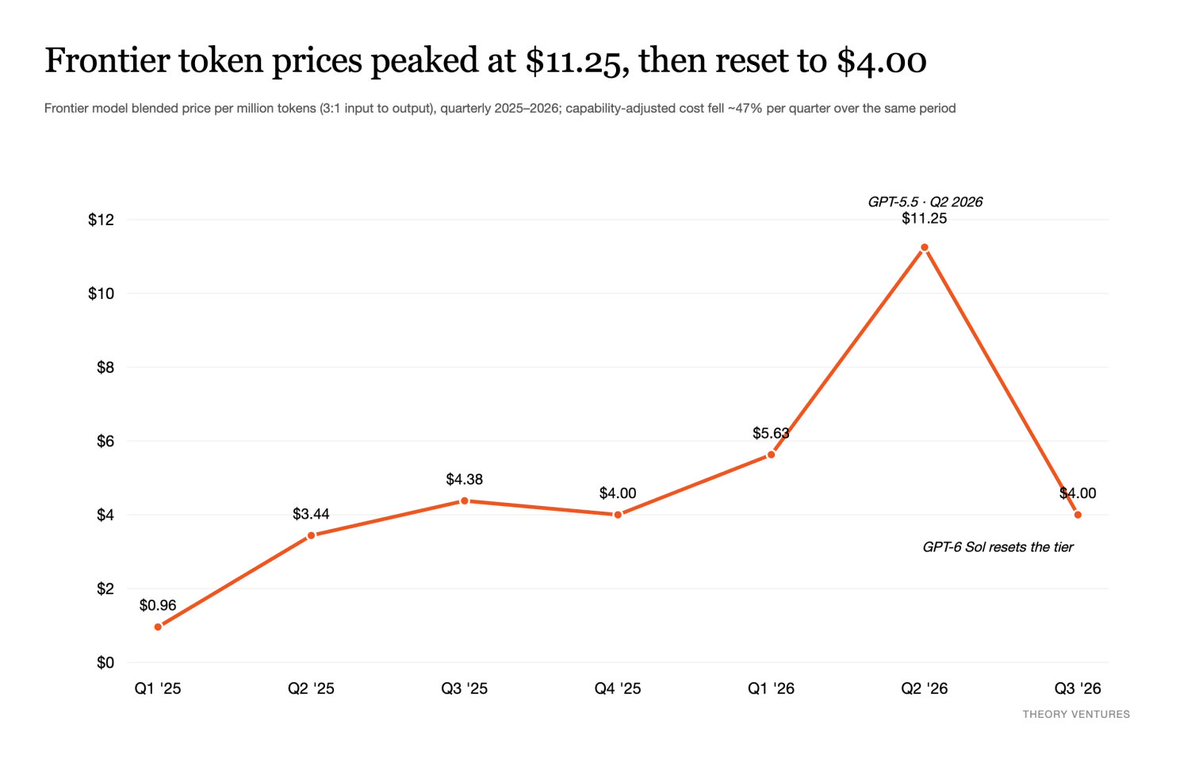
Could the AI price war prevent some of these changes? Capability-adjusted token costs fall ~47% each quarter.4 But list prices for frontier flagships keep resetting upward as capability leaps: the frontier blended price rose from $0.96 to $11.25 in 18 months before GPT-6 Sol reset the tier to $4.00.
These economics matter tremendously to the application layer. Infrastructure costs are suddenly a significant contributor to overall COGS, & potentially more than half of revenue is allocated to it.
Just like a long-haul trucker watching diesel surge beyond $8 per gallon & wondering about their economics, software companies will watch price per token & hunt for efficiencies on their rigs with smaller models, better harnesses, & new routing techniques.
& that creates plenty of opportunity for innovation.
- https://www.gartner.com/en/documents/7229830
- https://tomtunguz.com/is-software-profitable/
- https://tomtunguz.com/the-harness-margin-opportunity/
- https://epoch.ai/publications/the-plunging-price-of-thought
THEORY VENTURES · OCTOBER 2026
Inference is the most important market in software
It reaches $350b in 2027, passing the $161b database market — market size in $ billions, 2025–2027, with an 80% confidence interval
Legend: AI inference (80% CI); Database market (Gartner)
2025: AI inference $25b; Database market $137b
2026: AI inference $130b; Database market $161b
2027: AI inference $350b; Database market $190b
Vertical axis: $0b to $400b. Horizontal axis: 2025, 2026, 2027.
THEORY VENTURES
Frontier token prices peaked at $11.25, then reset to $4.00
Frontier model blended price per million tokens (3:1 input to output), quarterly 2025–2026; capability-adjusted cost fell ~47% per quarter over the same period
Q1 '25: $0.96; Q2 '25: $3.44; Q3 '25: $4.38; Q4 '25: $4.00; Q1 '26: $5.63; Q2 '26: $11.25 (GPT-5.5 · Q2 2026); Q3 '26: $4.00 (GPT-6 Sol resets the tier)
Vertical axis: $0 to $12.
THEORY VENTURES