saved
The future of ruthless optimizers and knowing a guy.
Hraness republishes this public post from a saved copy. The post is the author’s own words.
digitally native vertical boy | partner @slow | writing a weekly newsletter
The future of ruthless optimizers and knowing a guy.
In normal life (pre agents) not everyone is a ruthless optimizer. Most of the time, most people are content to take the path of least resistance while a few freaks value-max their way through life. Essentially your laziness or indifference pays for my margin or surplus.
But now it’s functionally free for everyone to operate that way.
The obvious - and wrong - first order conclusion is that everyone will be more efficient and find lots of new value. But this is a relative value game; not everyone can cleverly cut the line, get special attention, or enjoy negative unit economics/subsidies. No system can support a population of 100% ruthless optimizers and rule exploiters while maintaining its steady state.
So the second order (correct) effect is that rather than being widely enjoyed, a bunch of these subsidies and deals will go away entirely.
- Credit card rewards are the most obvious example of this. The disinterested subsidize the reward hackers.
- Restaurant reservations are the canonical example where only so many people can spam and DDOS the system to force their way to the front of the line.
- Subscription businesses often count on low utilization and cancellation rates which keeps the prices lower, subsidizing the optimizers and value extractors.
- Customer service and retention offers work the same way. The cable discount exists because few people call and threaten to cancel.
- Mortgage rates are priced on the assumption only a limited number of people will refinance when rates drop. Morgan Stanley thinks AI agents could push refi frequency 2x, leading to basis point increases in mortgage rates overall.
- Banks rely on cheap (low interest) deposits to make loans. Apollo speculated that agents could cause banking runs and drive up the cost of capital economy-wide by sweeping cash automatically.
- In medical billing, my relative unwillingness/inability to upcode makes it profitable for you to do so. Now it’s ubiquitous, driving up the overall administrative costs according to BCBS as both sides deploy AI against each other.
The introduction/proliferation of the infinite optimization machine (on-demand intelligence and personal intelligence) won’t create new supply of scarce assets (physical resources, attention, etc.) but will substantially/infinitely create new demand for them, especially as agents recursively fight with one another.
The list is basically infinite. Dating apps, driving directions, networking, the court system - so much of our economy and society relies on low agency (low propensity for ruthless exploitation and optimization) to function.
In the near future of ubiquitous personal agents, the economic SOP will shift toward ruthless optimization and you should expect higher, not lower barriers to surplus and service everywhere. Deals will go away because of active defense as agents are deployed against agents for the purpose of obfuscation and obstruction.
Edge will move from “agency” (really, persistence and optimization - and at the limit a willingness to trash the commons) to more proprietary channels that rote agent execution can’t replicate. In the simplest terms that means “knowing a guy” or “showing up in a room.” So that probably means legible “hacks” go away as this meritocratic subsidy.
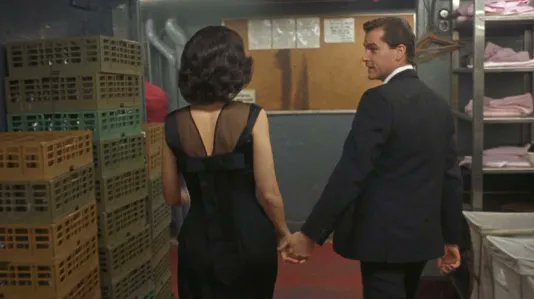
Cutting the line at the Copacabana
In some arenas agents will make life more meritocratic, because a person can do more things more easily if they are willing to.
But everyone will have them with the same rough capabilities, which clearly is redistributive at best and value destructive/zero sum at worst. And even where compute sufficient to execute long run or complex tasks is wildly inequitable, human attention will remain the primary bottleneck on real world actions and scarce resources. Again, redistributive.
The whole economy is gonna become more competitive and everyone will NEED to become an optimizer (or “hire” an agent to do so) to overcome the newly erected barriers to surplus value. A bunch of weird stuff will happen vs the clear “things will get better” or “everyone wins” first order effects.
The whole economy will look like HFT on one hand and “knowing a guy” on the other.
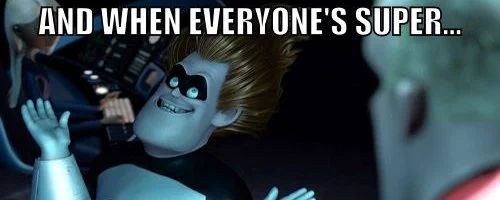
AND WHEN EVERYONE'S SUPER...
Cutting the line at the Copacabana (Goodfellas Copacabana back-entrance still: Henry Hill and Karen walk hand-in-hand through the service corridor).