saved
Stripe's letter on acquiring OpenRouter
Hraness republishes this public post from a saved copy. The post is the author’s own words.
Founder + author of Newcomer – a startups and VC newsletter & events company. Host summits, including Cerebral Valley AI Summit. Subscribe https://t.co/ptjq4pjVS9
Here's Stripe's letter to investors explaining its acquisition of OpenRouter (LEAKED)
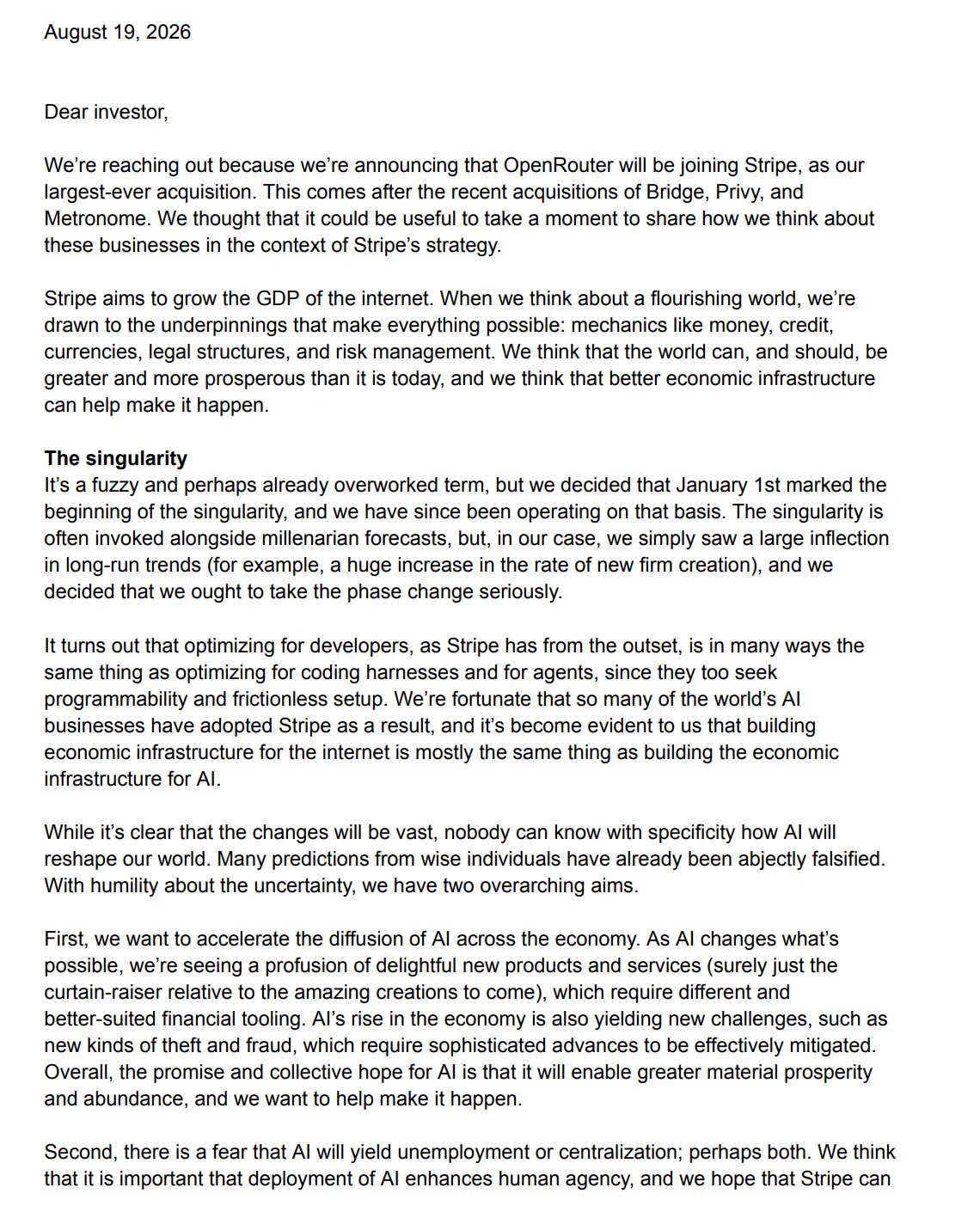
August 19, 2026
Dear investor,
We’re reaching out because we’re announcing that OpenRouter will be joining Stripe, as our largest-ever acquisition. This comes after the recent acquisitions of Bridge, Privy, and Metronome. We thought that it could be useful to take a moment to share how we think about these businesses in the context of Stripe’s strategy.
Stripe aims to grow the GDP of the internet. When we think about a flourishing world, we’re drawn to the underpinnings that make everything possible: mechanics like money, credit, currencies, legal structures, and risk management. We think that the world can, and should, be greater and more prosperous than it is today, and we think that better economic infrastructure can help make it happen.
The singularity
It’s a fuzzy and perhaps already overworked term, but we decided that January 1st marked the beginning of the singularity, and we have since been operating on that basis. The singularity is often invoked alongside millenarian forecasts, but, in our case, we simply saw a large inflection in long-run trends (for example, a huge increase in the rate of new firm creation), and we decided that we ought to take the phase change seriously.
It turns out that optimizing for developers, as Stripe has from the outset, is in many ways the same thing as optimizing for coding harnesses and for agents, since they too seek programmability and frictionless setup. We’re fortunate that so many of the world’s AI businesses have adopted Stripe as a result, and it’s become evident to us that building economic infrastructure for the internet is mostly the same thing as building the economic infrastructure for AI.
While it’s clear that the changes will be vast, nobody can know with specificity how AI will reshape our world. Many predictions from wise individuals have already been abjectly falsified. With humility about the uncertainty, we have two overarching aims.
First, we want to accelerate the diffusion of AI across the economy. As AI changes what’s possible, we’re seeing a profusion of delightful new products and services (surely just the curtain-raiser relative to the amazing creations to come), which require different and better-suited financial tooling. AI’s rise in the economy is also yielding new challenges, such as new kinds of theft and fraud, which require sophisticated advances to be effectively mitigated. Overall, the promise and collective hope for AI is that it will enable greater material prosperity and abundance, and we want to help make it happen.
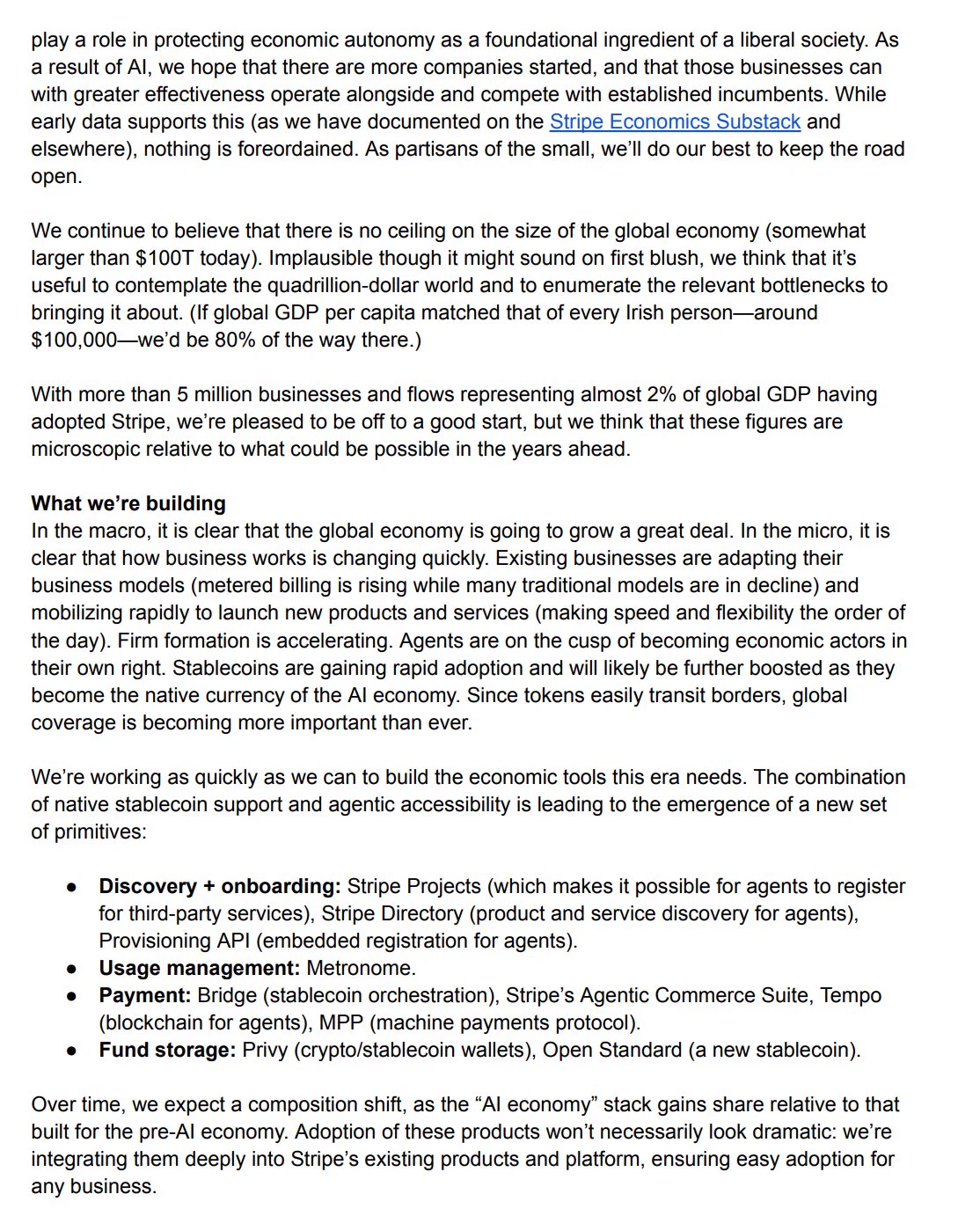
Second, there is a fear that AI will yield unemployment or centralization; perhaps both. We think that it is important that deployment of AI enhances human agency, and we hope that Stripe can play a role in protecting economic autonomy as a foundational ingredient of a liberal society. As a result of AI, we hope that there are more companies started, and that those businesses can with greater effectiveness operate alongside and compete with established incumbents. While early data supports this (as we have documented on the Stripe Economics Substack and elsewhere), nothing is foreordained. As partisans of the small, we’ll do our best to keep the road open.
We continue to believe that there is no ceiling on the size of the global economy (somewhat larger than $100T today). Implausible though it might sound on first blush, we think that it’s useful to contemplate the quadrillion-dollar world and to enumerate the relevant bottlenecks to bringing it about. (If global GDP per capita matched that of every Irish person—around $100,000—we’d be 80% of the way there.)
With more than 5 million businesses and flows representing almost 2% of global GDP having adopted Stripe, we’re pleased to be off to a good start, but we think that these figures are microscopic relative to what could be possible in the years ahead.
What we’re building
In the macro, it is clear that the global economy is going to grow a great deal. In the micro, it is clear that how business works is changing quickly. Existing businesses are adapting their business models (metered billing is rising while many traditional models are in decline) and mobilizing rapidly to launch new products and services (making speed and flexibility the order of the day). Firm formation is accelerating. Agents are on the cusp of becoming economic actors in their own right. Stablecoins are gaining rapid adoption and will likely be further boosted as they become the native currency of the AI economy. Since tokens easily transit borders, global coverage is becoming more important than ever.
We’re working as quickly as we can to build the economic tools this era needs. The combination of native stablecoin support and agentic accessibility is leading to the emergence of a new set of primitives:
Discovery + onboarding: Stripe Projects (which makes it possible for agents to register for third-party services), Stripe Directory (product and service discovery for agents), Provisioning API (embedded registration for agents).
Usage management: Metronome.
Payment: Bridge (stablecoin orchestration), Stripe’s Agentic Commerce Suite, Tempo (blockchain for agents), MPP (machine payments protocol).
Fund storage: Privy (crypto/stablecoin wallets), Open Standard (a new stablecoin).
Over time, we expect a composition shift, as the “AI economy” stack gains share relative to that built for the pre-AI economy. Adoption of these products won’t necessarily look dramatic: we’re integrating them deeply into Stripe’s existing products and platform, ensuring easy adoption for any business.
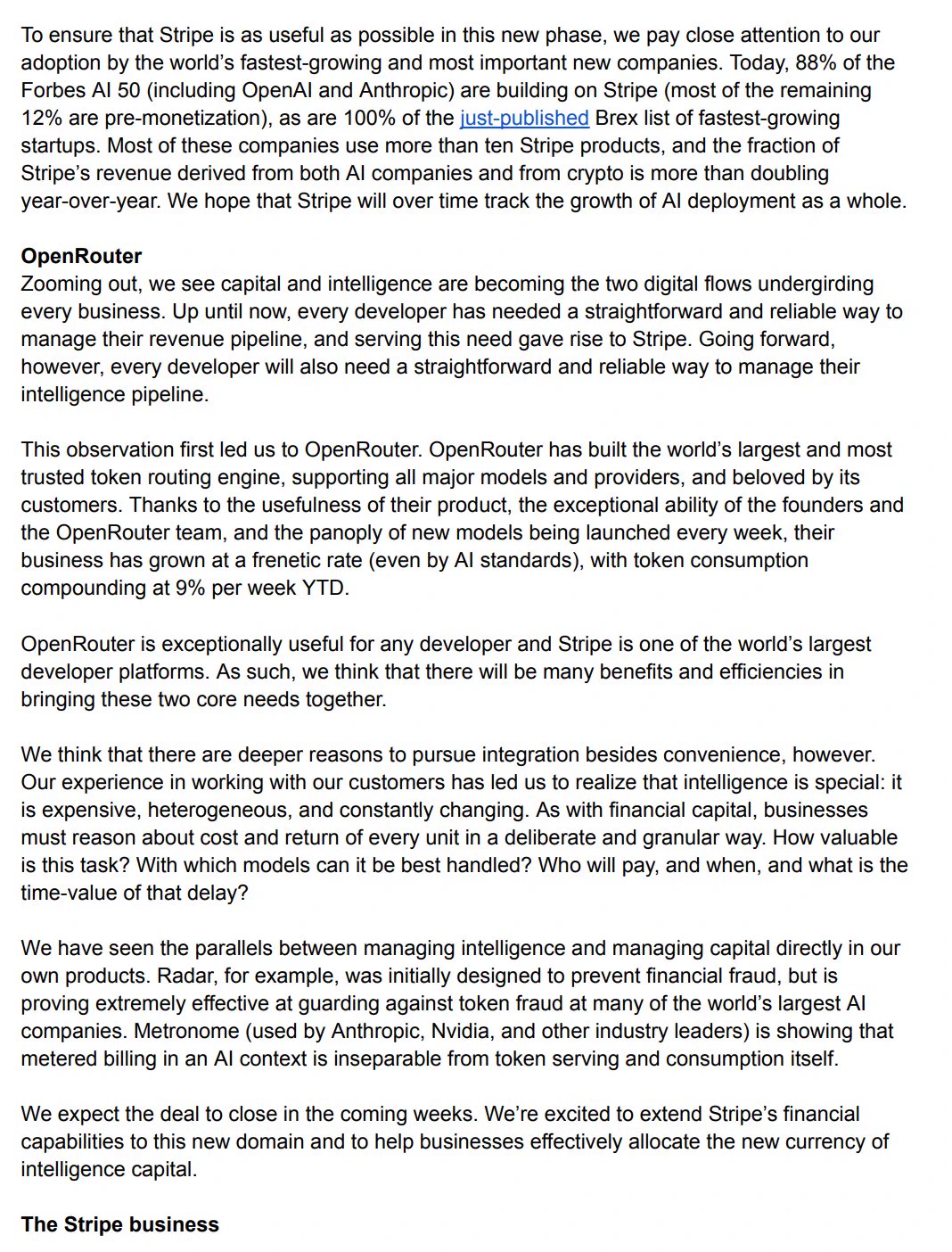
To ensure that Stripe is as useful as possible in this new phase, we pay close attention to our adoption by the world’s fastest-growing and most important new companies. Today, 88% of the Forbes AI 50 (including OpenAI and Anthropic) are building on Stripe (most of the remaining 12% are pre-monetization), as are 100% of the just-published Brex list of fastest-growing startups. Most of these companies use more than ten Stripe products, and the fraction of Stripe’s revenue derived from both AI companies and from crypto is more than doubling year-over-year. We hope that Stripe will over time track the growth of AI deployment as a whole.
OpenRouter
Zooming out, we see capital and intelligence are becoming the two digital flows undergirding every business. Up until now, every developer has needed a straightforward and reliable way to manage their revenue pipeline, and serving this need gave rise to Stripe. Going forward, however, every developer will also need a straightforward and reliable way to manage their intelligence pipeline.
This observation first led us to OpenRouter. OpenRouter has built the world’s largest and most trusted token routing engine, supporting all major models and providers, and beloved by its customers. Thanks to the usefulness of their product, the exceptional ability of the founders and the OpenRouter team, and the panoply of new models being launched every week, their business has grown at a frenetic rate (even by AI standards), with token consumption compounding at 9% per week YTD.
OpenRouter is exceptionally useful for any developer and Stripe is one of the world’s largest developer platforms. As such, we think that there will be many benefits and efficiencies in bringing these two core needs together.
We think that there are deeper reasons to pursue integration besides convenience, however. Our experience in working with our customers has led us to realize that intelligence is special: it is expensive, heterogeneous, and constantly changing. As with financial capital, businesses must reason about cost and return of every unit in a deliberate and granular way. How valuable is this task? With which models can it be best handled? Who will pay, and when, and what is the time-value of that delay?
We have seen the parallels between managing intelligence and managing capital directly in our own products. Radar, for example, was initially designed to prevent financial fraud, but is proving extremely effective at guarding against token fraud at many of the world’s largest AI companies. Metronome (used by Anthropic, Nvidia, and other industry leaders) is showing that metered billing in an AI context is inseparable from token serving and consumption itself.
We expect the deal to close in the coming weeks. We’re excited to extend Stripe’s financial capabilities to this new domain and to help businesses effectively allocate the new currency of intelligence capital.
The Stripe business
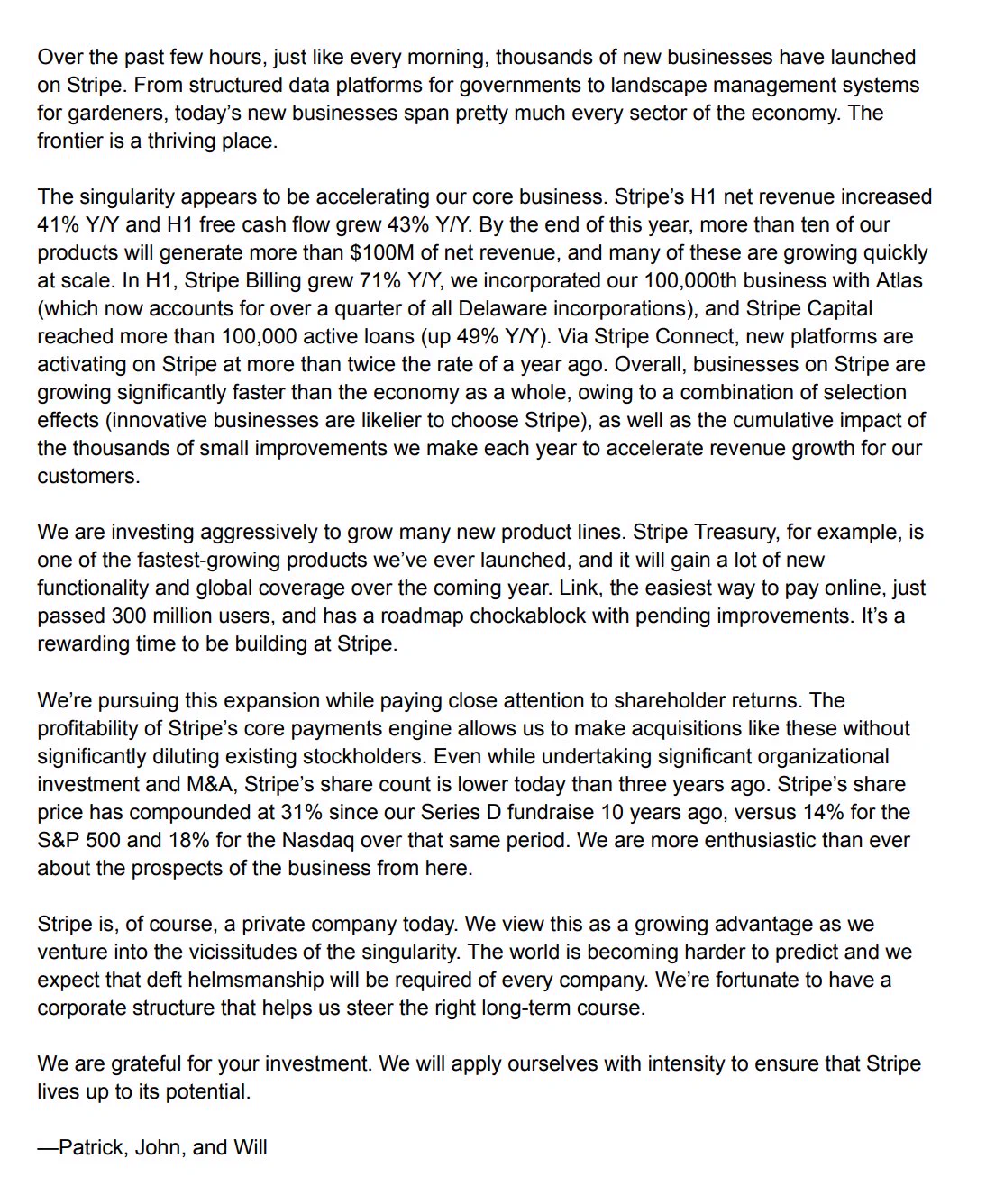
Over the past few hours, just like every morning, thousands of new businesses have launched on Stripe. From structured data platforms for governments to landscape management systems for gardeners, today’s new businesses span pretty much every sector of the economy. The frontier is a thriving place.
The singularity appears to be accelerating our core business. Stripe’s H1 net revenue increased 41% Y/Y and H1 free cash flow grew 43% Y/Y. By the end of this year, more than ten of our products will generate more than $100M of net revenue, and many of these are growing quickly at scale. In H1, Stripe Billing grew 71% Y/Y, we incorporated our 100,000th business with Atlas (which now accounts for over a quarter of all Delaware incorporations), and Stripe Capital reached more than 100,000 active loans (up 49% Y/Y). Via Stripe Connect, new platforms are activating on Stripe at more than twice the rate of a year ago. Overall, businesses on Stripe are growing significantly faster than the economy as a whole, owing to a combination of selection effects (innovative businesses are likelier to choose Stripe), as well as the cumulative impact of the thousands of small improvements we make each year to accelerate revenue growth for our customers.
We are investing aggressively to grow many new product lines. Stripe Treasury, for example, is one of the fastest-growing products we’ve ever launched, and it will gain a lot of new functionality and global coverage over the coming year. Link, the easiest way to pay online, just passed 300 million users, and has a roadmap chockablock with pending improvements. It’s a rewarding time to be building at Stripe.
We’re pursuing this expansion while paying close attention to shareholder returns. The profitability of Stripe’s core payments engine allows us to make acquisitions like these without significantly diluting existing stockholders. Even while undertaking significant organizational investment and M&A, Stripe’s share count is lower today than three years ago. Stripe’s share price has compounded at 31% since our Series D fundraise 10 years ago, versus 14% for the S&P 500 and 18% for the Nasdaq over that same period. We are more enthusiastic than ever about the prospects of the business from here.
Stripe is, of course, a private company today. We view this as a growing advantage as we venture into the vicissitudes of the singularity. The world is becoming harder to predict and we expect that deft helmsmanship will be required of every company. We’re fortunate to have a corporate structure that helps us steer the right long-term course.
We are grateful for your investment. We will apply ourselves with intensity to ensure that Stripe lives up to its potential.
—Patrick, John, and Will