saved
Recursive Meta-Intelligence
Hraness cites a source capture. The source author remains the source.
Markus J. Buehler @ProfBuehlerMIT
McAfee Professor of Engineering @MIT; Co-Founder & CTO at Unreasonable Labs; AI-Driven Scientific Discovery
Recursive Meta-Intelligence
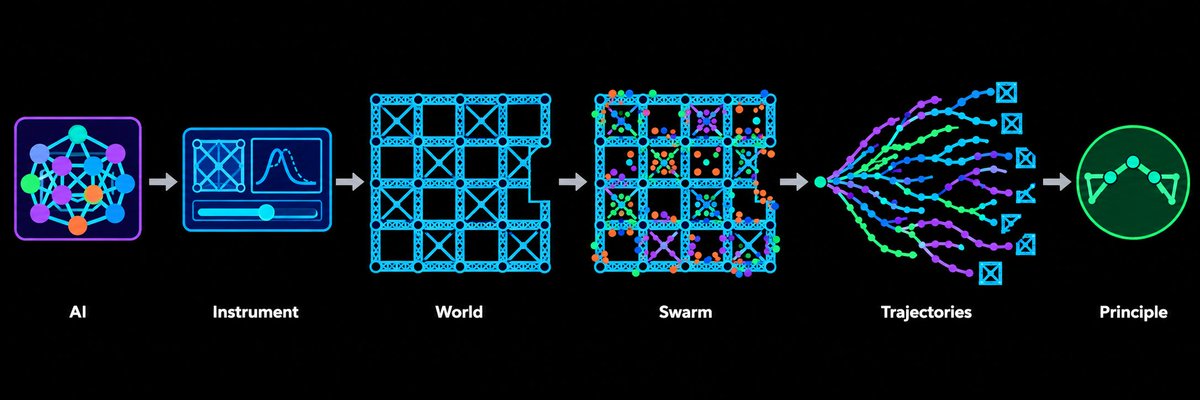
We built a recursive AI that creates its own scientific instruments, turns them into a world inhabited by a massive agent ecology, which then reasons across vast, nonlinear spaces of possible physical futures. The AI swarm worked until tens of thousands of trajectories collapsed into mechanistic principles humans can use, distilling several core design principles that govern hierarchical metamaterials failure. The core tenet of this work is that AI can build the spaces in which its next level of reasoning becomes possible; a representation becomes an instrument, the instrument becomes an executable world, and that world becomes the substrate for further intelligence, forming a recursive loop. Intelligence grows by constructing new spaces to think in and improving its own thinking.
The world created by the initial set of agents is later populated by hundreds of AI agents. They explore a vast design universe where chemistry remains fixed and architecture creates functionality: nested, inter-woven structures within structures forming an incredibly complex design space. Here, the same constituent material can behave radically differently depending on where matter is placed, how it’s connected, and how order and disorder are distributed across scales. Architecture adds combinatorial degrees of freedom to a problem that is already strongly nonlinear and path dependent, especially when we examine how materials deform, and behave dynamically as they exposed to extreme pressures, and fail.
Every rupture changes the topology, redistributes force, and creates a new state. Cascades emerge from the evolving state of the material itself. Out of that complexity came a remarkably compact recurring result: hierarchy by itself does not determine performance; rather, the decisive variable is how the architecture organizes pathways through which forces are carried and redistributed as damage accumulates. The gain appeared when material was allocated into a dominant load-bearing structure. Placement of geometric order set whether failure progressed through smaller events or synchronized collapse. That opened a regime of surprising flaw tolerance with real trade-offs and real-world engineering implications.
The core discovery by the AI is that making materials damage resilient can be achieved by shaping the architecture so that once failure begins, the material is driven through a sequence of states that preserve function. The crucial point is dynamical - each rupture rewrites the topology, redistributes force and energy and creates a new state. The full response is a path-dependent evolution with avalanches and non-separable interactions in which the effect of one design choice depends on the others.
What is striking is the level of scientific cognition brought to that problem. The AI held a generative model of an evolving world, stepped outside the immediate state, rolled out alternative futures, compared long causal histories, identified interventions that changed which trajectories were reachable, and compressed those histories into a small set of generative invariants. This connects to model-based causal reasoning, counterfactual simulation, cognitive decoupling, and temporal abstraction.
Deeper reasoning
Reasoning over what could happen, how histories unfold, and which hidden mechanisms remain invariant across them. The resulting principle is profound: Architecture can program the evolution of failure. Geometry gives us a way to shape how a physical system moves through its possible future states under damage. That, in turn, transforms a vast nonlinear space into a powerful design handle: shape the future trajectory of matter under damage so function can persist deep into the failure process.
But perhaps most interestingly in my opinion, the larger impact is an expansion of the human epistemic horizon. Science progresses by extending what a mind can hold. Instruments extend perception, computation extends calculation, systems like this extend the size of the causal possibility space we can traverse before abstraction.
The Swarm Habitat
AI can inhabit thousands of alternatives, follow enormous numbers of possible histories, and return with mechanisms compact enough for us to reason with. That creates a form of extended cognition for science. Our effective scientific intelligence incorporates models, executable worlds, persistent evidence, and populations of artificial investigators. Machine scale exploration can be compressed into human scale understanding. Principles we can argue with, generalize, manufacture from, use to design the next experiment.
The recursion is powerful; the first agents define a scientific world and that world becomes shared cognition. Other current and future agents explore it, add evidence, retrieve and build further investigations through the same persistent instrument. This creates a flywheel of thinking - answer to instrument, instrument to world, world to ecology, and every step of the way is an editable artifact that serves as the basis for further improvement. Intelligence compounds through what the agents build, creating an intelligence explosion in science: designers constructing the possibility spaces in which other designers reason, experiment, and discover.
Flows through spaces of possibility
At a general level, learning and discovery are flows through spaces of possibility under constraint. In backpropagation, the flow moves through parameter space under a specified loss. In reinforcement learning, it’s coupled to an environment via rewards. In a fully autonomous scientific system, that flow becomes reflexive. The system moves beyond internal state updates and and buconstructs, manipulates, and repairs the executable worlds that define what its objectives, variables, and questions even are.
The universal pattern is a recurring coupling between possibility, constraint, consequence, and memory. Flows create structure, and structures redirect flows. As that loop scales from parameters to policies to representations to instruments and worlds, Intelligence is no longer confined to one fixed space; it begins to create the next space within which it can think.
Evolutionary tales
The evolution from RNNs to LSTMs to transformers (and later, looped transformers and other variants) can be read as a history of where intelligence places persistence, where it permits change, and how it carries structure from one cycle of computation into the next. RNNs compress the past into an evolving hidden state; LSTMs introduce gates that preserve selected information across longer horizons; transformers make prior tokens directly addressable as context and continually recompute relationships across that persistent substrate. Looped transformers reuse a stable computational operator while representations evolve through repeated passes.
Recursive self-evolving intelligence extends this principle beyond the internal architecture of a model and amalgamates multiple levers to create referential updates.
Representations, memories, tools, scientific instruments, executable worlds, and eventually entire societies of agents can become persistent and ever-evolving substrates that carry the products of one round of cognition into the next. Each cycle can stabilize what has been learned, turn it into a new object for reasoning, and open a larger possibility space above it.
Intelligence therefore acquires a multiscale architecture of persistence and plasticity: fast processes explore, slower structures accumulate, and the outputs of cognition become the invariants from which subsequent cognition proceeds. This gives recursion its real power, because once a system can experience a world, it can build structures that encode what it has learned, it can reason through those structures, revise them through consequence, and repeatedly create new levels on which further intelligence can operate.
A bright future
AI for science is one of the greatest positive forces we have. It expands the human epistemic horizon - letting us traverse thousands of possible histories, invent new instruments we would never have time to build by hand, and return mechanisms compact enough to understand, test, and manufacture. For scientists, this becomes a new instrument to explore the world, a new microscope, a new tool, a new way look deeply into the world and to make sense of it. I cannot think of anything more human than to understand nature and to use the power to create new engineering solutions that improve our lives, civilization and allow us to reach beyond.
We are just at the beginning of an exciting journey, and scientific superintelligence may emerge from a process in which complex activity generates stable abstractions that become the building blocks for a new level of reasoning. There is significant earlier work that becomes increasingly relevant as material intelligence is unlocked.
For instance, cybernetics and nonlinear physics offer a coherent theoretical underpinning; for instance, a system can cope with a complex environment only if it can generate sufficient internal variety, and in some regimes, it can reorganize the very mechanisms by which it remains stable. Repeated interaction can generate stable forms that become the “objects” of the next round of reasoning, while networks of processes can close on themselves to constitute a coherent level of organization.
In physics, large numbers of degrees of freedom can collapse into a few collective variables that then feed back to organize the lower level, and far from equilibrium, sustained flows can stabilize macroscopic order that was not there before. Put together, this suggests a very specific kind of scaling: High-dimensional activity produces a stable invariant. That invariant becomes an effective variable that compresses the complexity.
That variable becomes a contract on which a new layer of reasoning can stand, creating a new dynamical space above it. The recursion is not simply repetition but rather creation of new levels of reasoning substrates. One space is compressed into a principle, that principle opens a larger space above it. This is, indeed, a deep foundation for scientific superintelligence where we repeatedly generate the very framework in which still greater reasoning becomes possible.
References and notes
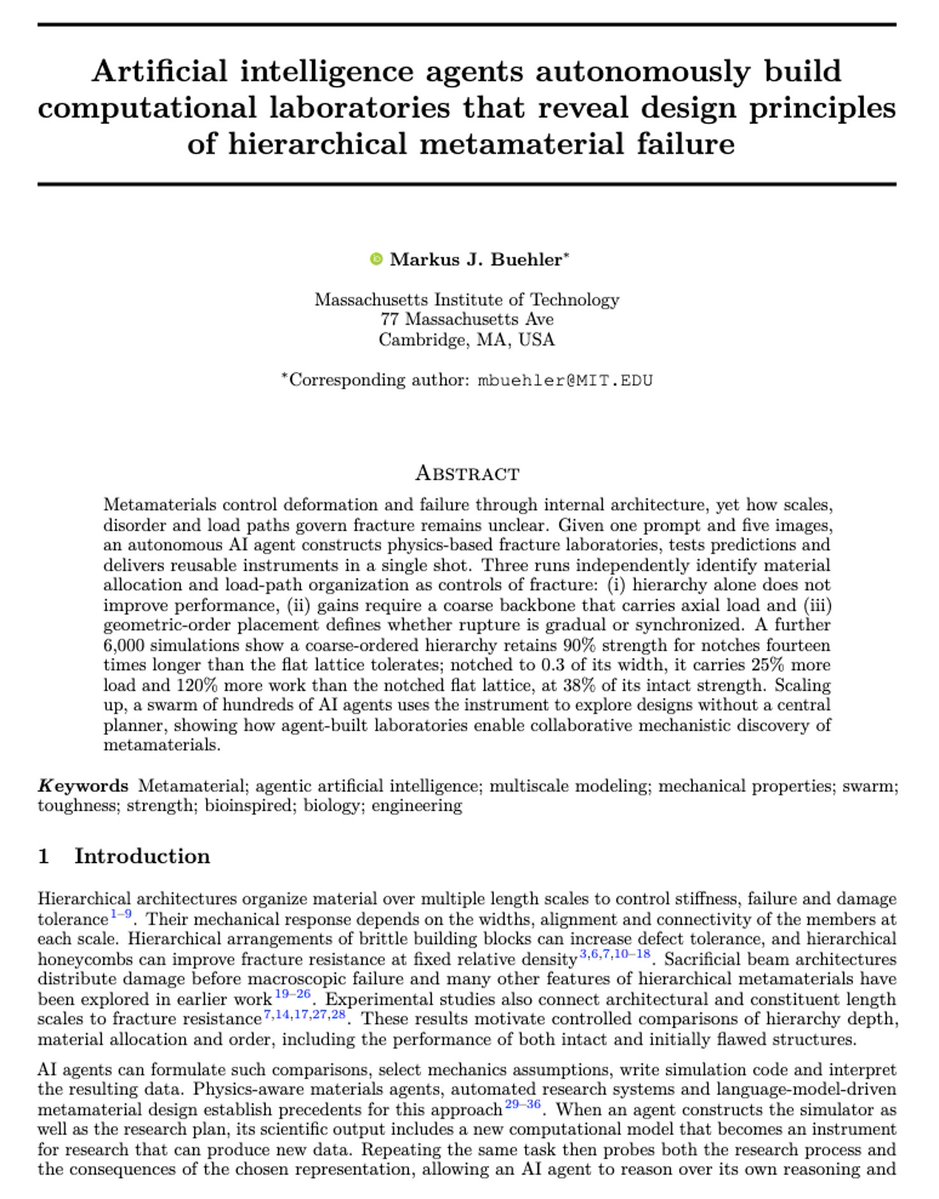
- M.J. Buehler, Artificial intelligence agents autonomously build computational laboratories that reveal design principles of hierarchical metamaterial failure, in submission, 2026
- S. Pal, F.Y. Wang, M.J. Buehler, SwarmWorld: Stigmergic technological evolution in societies of language-model agents, arXiv:2608.26081, 2026
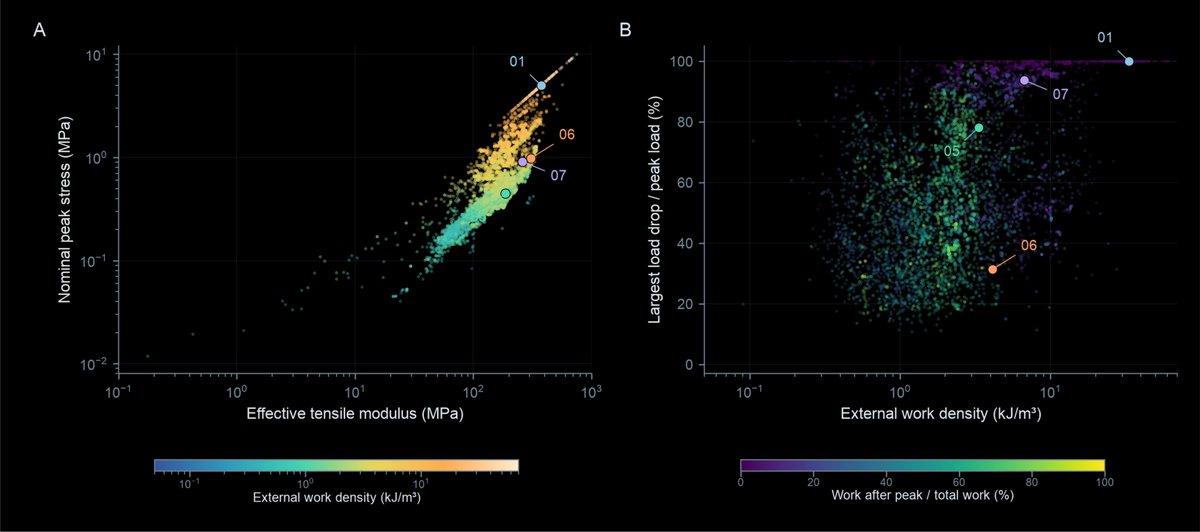
Plot A. Nominal peak stress (MPa) versus Effective tensile modulus (MPa), both logarithmic. Points colored by External work density (kJ/m^3) from low (blue) to high (yellow/white). Highlighted samples 01, 05, 06, 07 track a positive log-log correlation.
Plot B. Largest load drop / peak load (%) versus External work density (kJ/m^3). Points colored by Work after peak / total work (%) from 0% (dark purple) to 100% (bright yellow). Highlighted samples 01, 05, 06, 07.
Pipeline diagram labels left to right: AI → Instrument → World → Swarm → Trajectories → Principle.
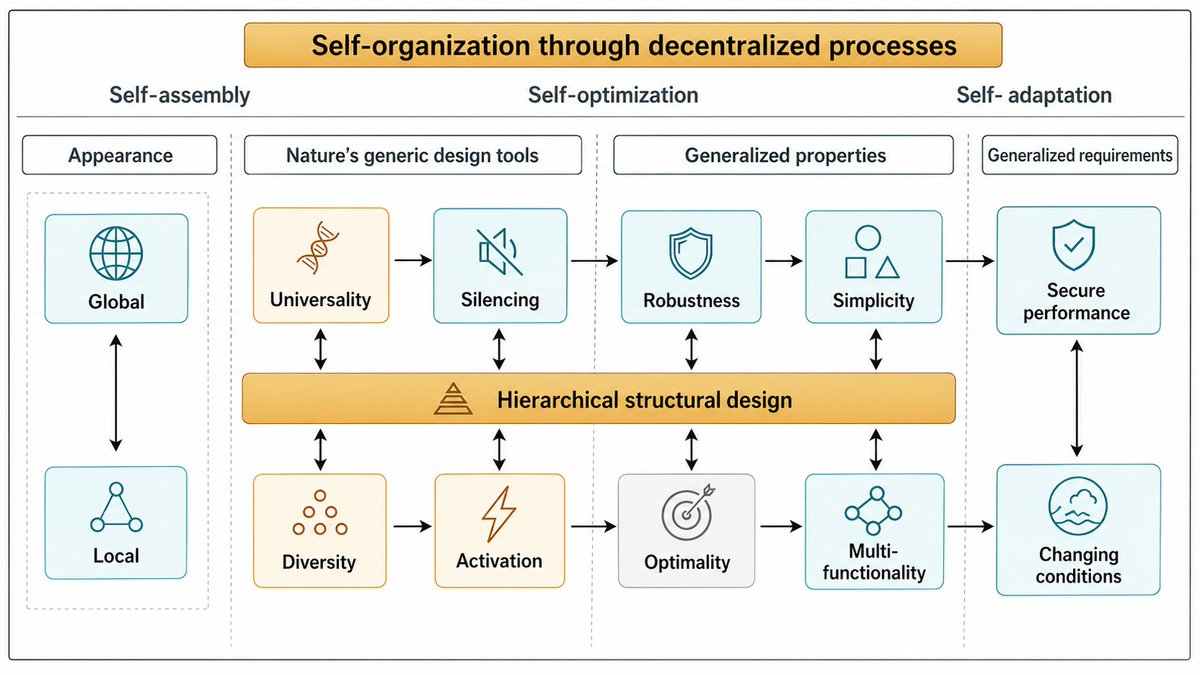
Diagram titled Self-organization through decentralized processes. Phases across the top: Self-assembly, Self-optimization, Self-adaptation. Columns: Appearance (Global, Local); Nature's generic design tools (Universality, Silencing, Diversity, Activation); Generalized properties (Robustness, Simplicity, Optimality, Multi-functionality); Generalized requirements (Secure performance, Changing conditions). Central bar: Hierarchical structural design.
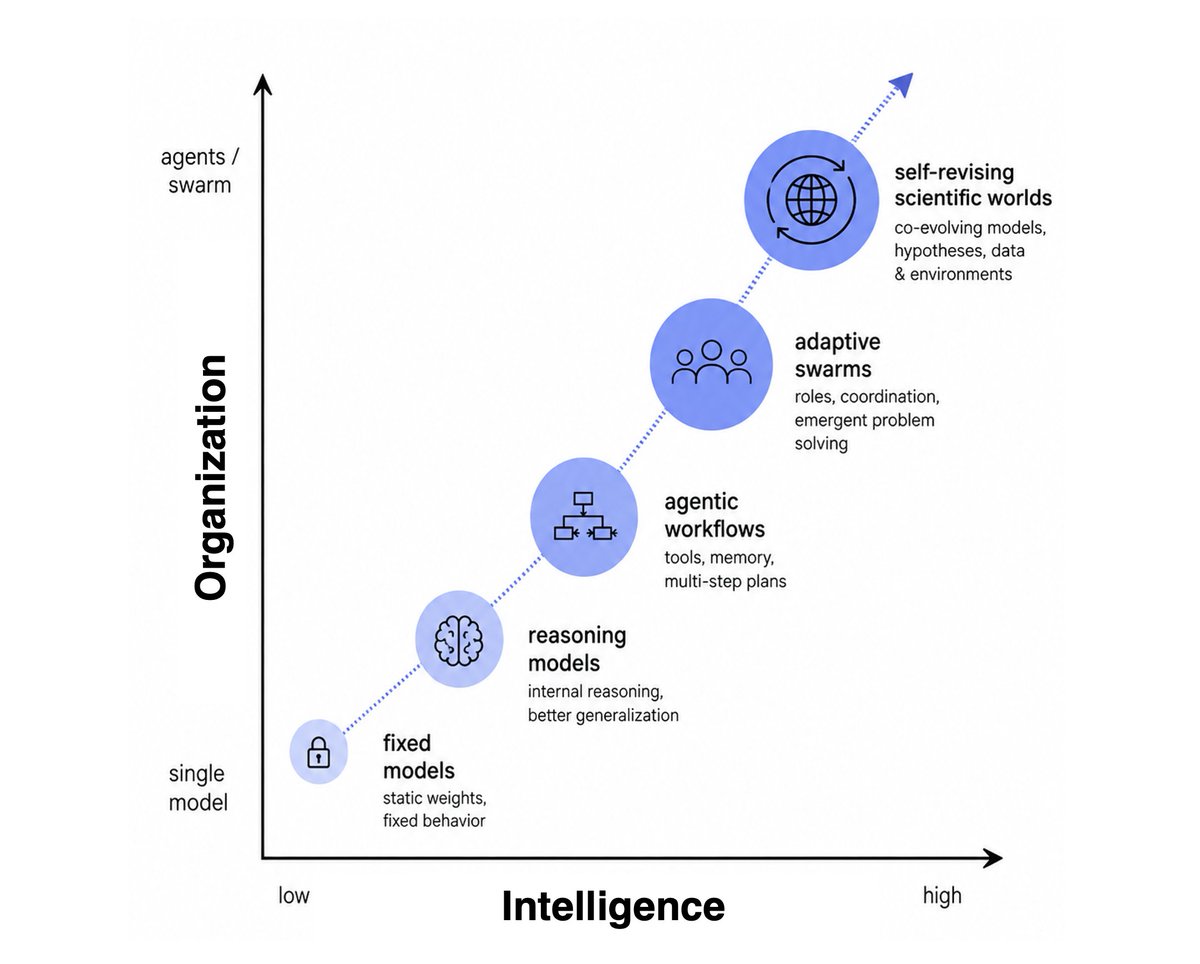
Chart of Intelligence (low to high) versus Organization (single model to agents / swarm). Stages along the diagonal: fixed models — static weights, fixed behavior; reasoning models — internal reasoning, better generalization; agentic workflows — tools, memory, multi-step plans; adaptive swarms — roles, coordination, emergent problem solving; self-revising scientific worlds — co-evolving models, hypotheses, data & environments.
Paper first page. Title: Artificial intelligence agents autonomously build computational laboratories that reveal design principles of hierarchical metamaterial failure. Author: Markus J. Buehler, Massachusetts Institute of Technology. Abstract: Metamaterials control deformation and failure through internal architecture, yet how scales, disorder and load paths govern fracture remains unclear. Given one prompt and five images, an autonomous AI agent constructs physics-based fracture laboratories, tests predictions and delivers reusable instruments in a single shot. Three runs independently identify material allocation and load-path organization as controls of fracture: (i) hierarchy alone does not improve performance, (ii) gains require a coarse backbone that carries axial load and (iii) geometric-order placement defines whether rupture is gradual or synchronized. A further 6,000 simulations show a coarse-ordered hierarchy retains 90% strength for notches fourteen times longer than the flat lattice tolerates; notched to 0.3 of its width, it carries 25% more load and 120% more work than the notched flat lattice, at 38% of its intact strength. Scaling up, a swarm of hundreds of AI agents uses the instrument to explore designs without a central planner, showing how agent-built laboratories enable collaborative mechanistic discovery of metamaterials. Keywords: Metamaterial; agentic artificial intelligence; multiscale modeling; mechanical properties; swarm; toughness; strength; bioinspired; biology; engineering.
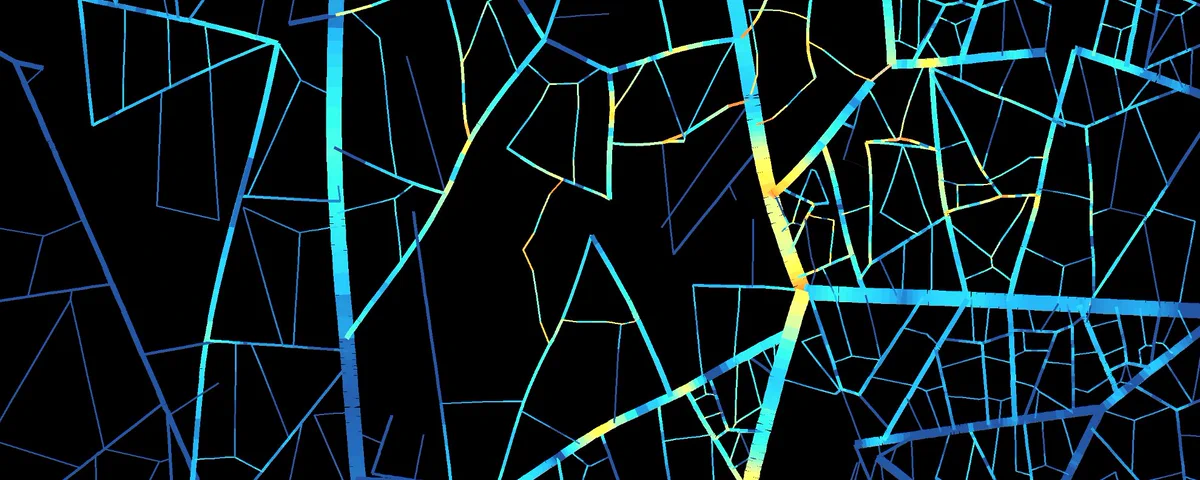
Cover visualization: network/lattice stress or flow map on black (no readable text).
Macro photograph: orb-weaver spider at the hub of its web holding a fly (no readable text).