saved
on cognition & embodiment—aka is ai going to take all our jobs
Hraness cites a source capture. The source author remains the source.
internet frolicker
on cognition & embodiment—aka is ai going to take all our jobs:
i’m a 2x dropout (not something to be proud of) across biomedical engineering, cognitive science, and information science. my most impactful prof across 3 majors was dr john vervaeke
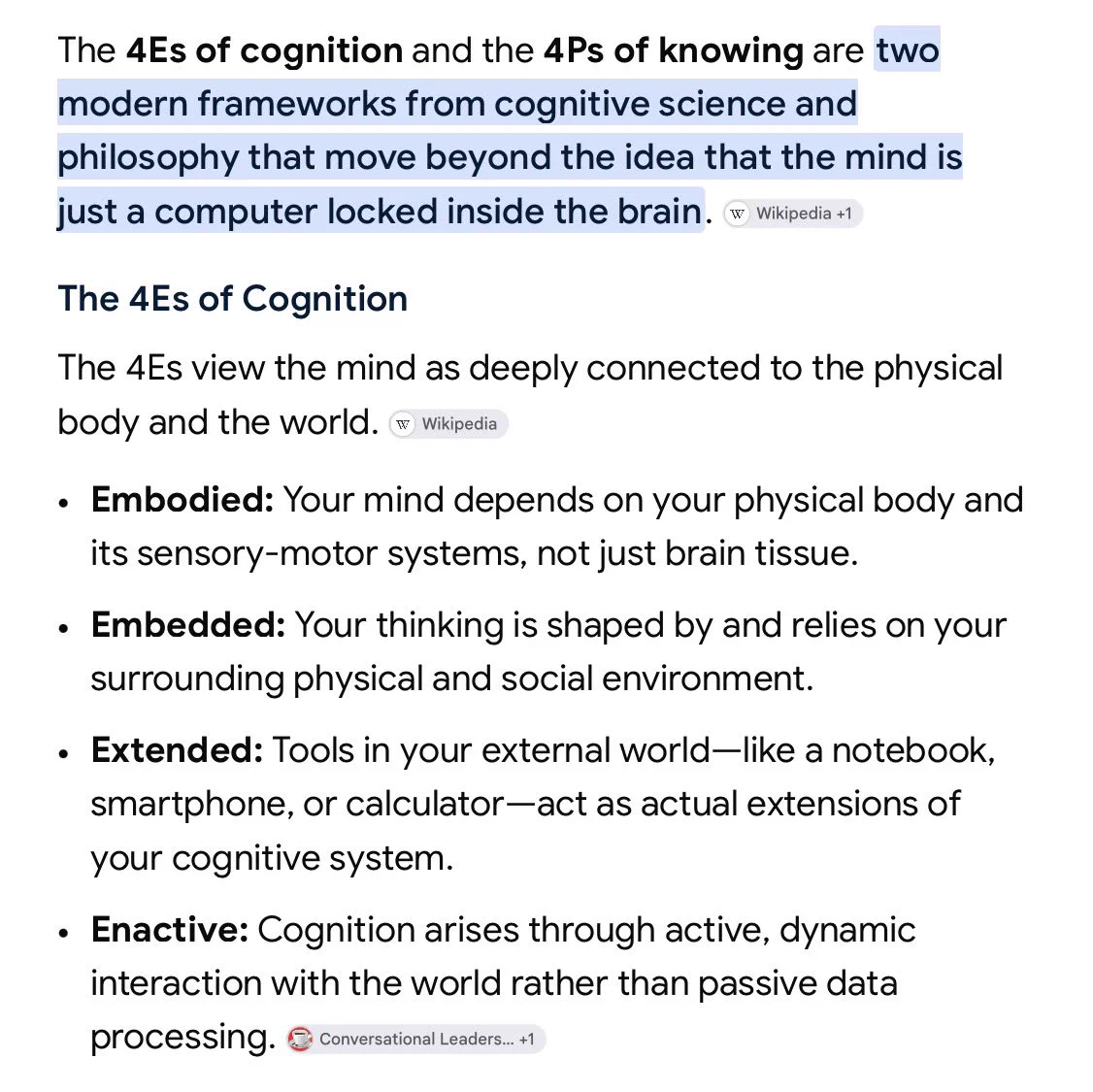
vervaeke developed the 4Es of cognition (if i’m not mistaken): cognition is 1) embodied 2) embedded 3) extended and 4) enactive
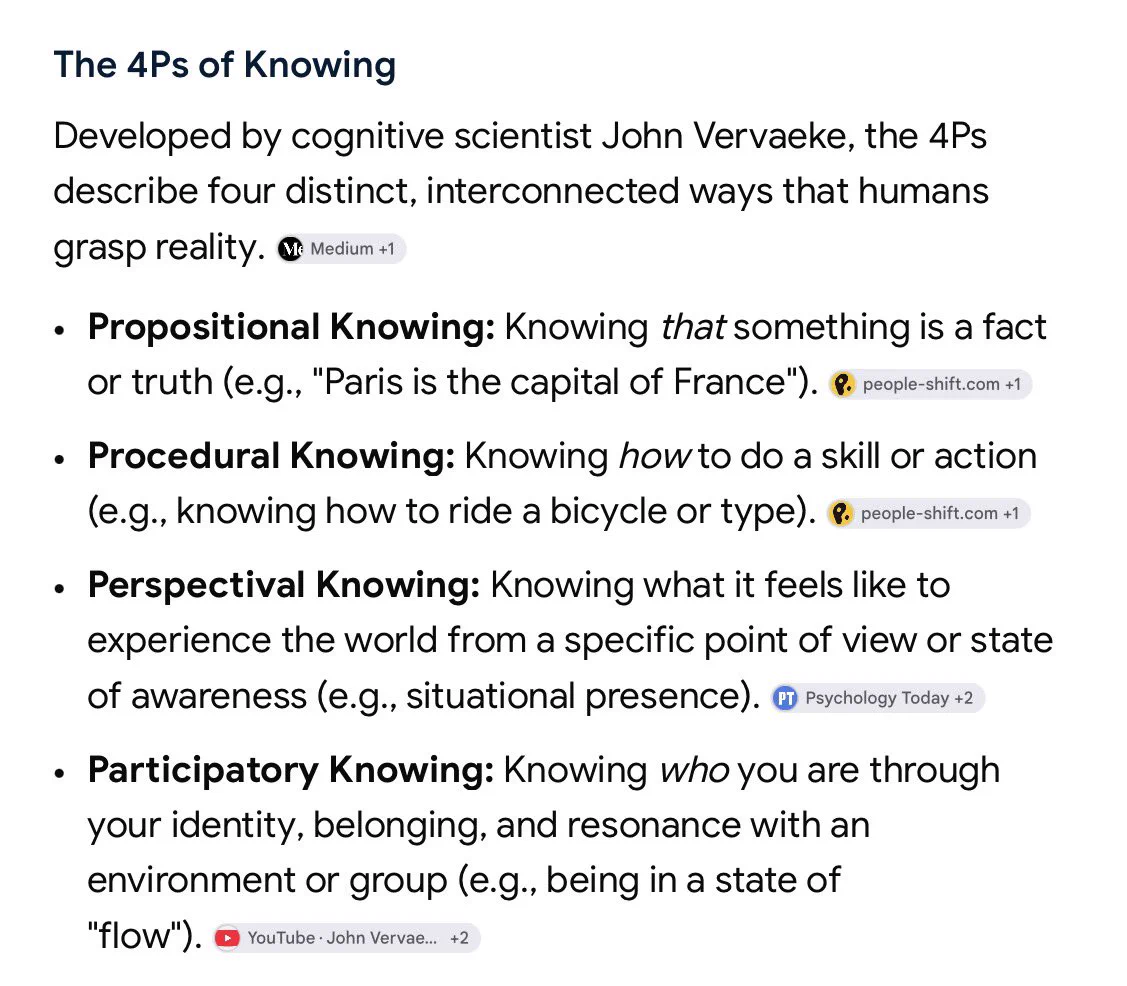
& 4Ps of knowing: 1) propositional 2) procedural 3) perspectival and 4) participatory
these frameworks are upstream of this: cognition cannot be simply reduced to a “brain in a box.” we’re seeing increasing diversity in artificial cognition. ML, CNNs, GANs, LLMs, and now synbio is once again picking up (real ones know from way back when)
LLMs feel reductive with worlds inside the embedding vectors. i may not be an ML scholar, but i am a girl who loves to ask and ponder. embodiment goes beyond simply seeing and doing—it is also feeling, noticing, perceiving, living.
what is lost in a world of compression? that data which we could not quantify its utility—perhaps it wasn’t so vestigial after all.
do vibes matter more than we might have thought?
i’m not sure yet! but i’ll be exploring these questions & more in my talk at @valiocon on friday. see u soon! :)
The 4Es of cognition and the 4Ps of knowing are two modern frameworks from cognitive science and philosophy that move beyond the idea that the mind is just a computer locked inside the brain. Wikipedia +1
The 4Es of Cognition
The 4Es view the mind as deeply connected to the physical body and the world. Wikipedia
Embodied: Your mind depends on your physical body and its sensory-motor systems, not just brain tissue.
Embedded: Your thinking is shaped by and relies on your surrounding physical and social environment.
Extended: Tools in your external world—like a notebook, smartphone, or calculator—act as actual extensions of your cognitive system.
Enactive: Cognition arises through active, dynamic interaction with the world rather than passive data processing. Conversational Leaders... +1
The 4Ps of Knowing
Developed by cognitive scientist John Vervaeke, the 4Ps describe four distinct, interconnected ways that humans grasp reality. Medium +1
Propositional Knowing: Knowing that something is a fact or truth (e.g., "Paris is the capital of France"). people-shift.com +1
Procedural Knowing: Knowing how to do a skill or action (e.g., knowing how to ride a bicycle or type). people-shift.com +1
Perspectival Knowing: Knowing what it feels like to experience the world from a specific point of view or state of awareness (e.g., situational presence). Psychology Today +2
Participatory Knowing: Knowing who you are through your identity, belonging, and resonance with an environment or group (e.g., being in a state of "flow"). YouTube · John Vervae... +2