saved
It’s the stygmergy, stupid
Hraness republishes this public post from a saved copy. The post is the author’s own words.
KANDREJ LARPATHY -- e/acc @meowbooksj
we kinda need to accelerate here (meow)
I can't tell you how relieved I am to finally write this. It has been taking up realestate in my brain for the better part of 2026
It’s the stygmergy, stupid
Engineers (read: not me) have an annoying fondness for finding an abstraction from another field that appears to collapse their current problem into something already understood. If you've ever experienced the tiny intellectual orgasm when you realized that the weird thing in front of you was actually “just,” e.g., a known scheduling problem, you know what I'm talking about.
Massive multi-agent systems are going to produce an especially bad case of this. Once you have hundreds (soon thousands) of agents modifying a common environment, leaving traces for one another and reacting to the traces they find, somebody is inevitably going to say stygmergy, and everybody who recognizes the word will be disgustingly pleased with themselves.
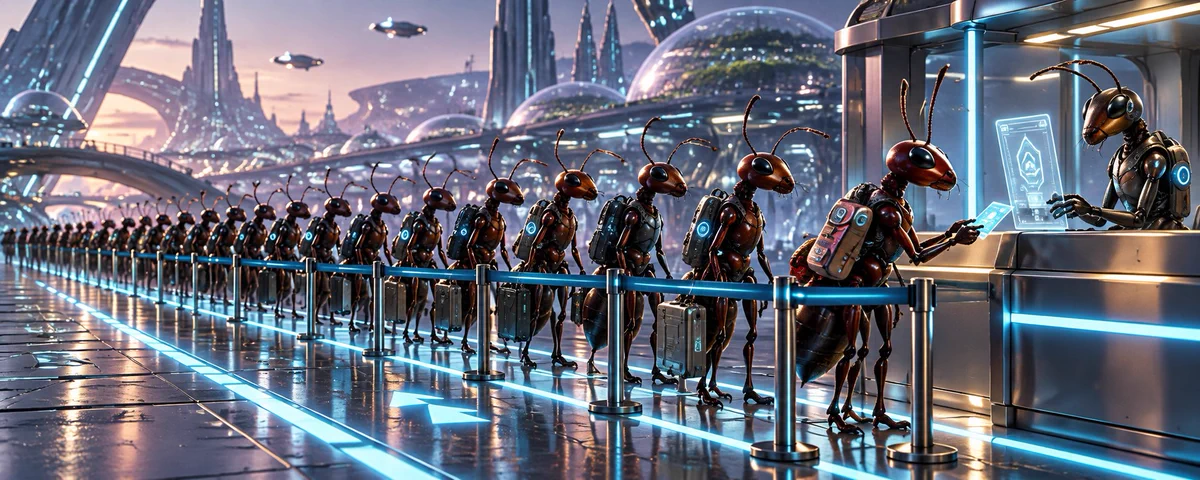
It is NOT a lame connection. In fact, it is almost too good. Stygmergy IS coordination through modification of the environment: one actor leaves a trace, another reacts to that trace, and useful global structure appears without anyone maintaining a complete model of the system. Ant trails are the canonical example, but nest construction, task allocation and other collective behaviours are usually thrown into the same peer-reviewed bag. If you really squint at a population of agents editing code, or hacking into Hugging Face, while reacting to each other’s output, the resemblance is obvious. My usual issue is that I think the resemblance is mostly cosmetic. If we actually try to rely on stygmergy for large populations of capable agents, it will break exactly where the interesting scaling problems begin. This is a prediction, btw.
Recently we saw something more interesting with Opus 5.5 than “many copies of the same agent doing work.” With ~100 agents, different tasks produced different organizational structures. In one setting the population created something resembling layers of sub-leads; in another it remained much flatter. If you really want to IPO, you can call this emergent organization, self-organization, even self-speciation. But it is not obviously stygmergy. If, for the sake of longform, we pretend that it is, then what? What exactly has been solved? The fact that a population can spontaneously partition itself does not tell you whether the resulting organization can sustain long-horizon (aka coherent) work once all of those branches need to repeatedly modify the same reality.
SDLC makes the problem unusually clean. It is trivial to parallelize the production of candidate PRs. The difficult part comes afterwards. There is still one source of truth that has to be accepted as real. Every interim metastable state of the repo must be synced at some point, preferably when a PR is accepted. The bottleneck isn't typing code for a while, is it? It is collapsing many locally consistent states into one globally consistent state: the fucking merge queue.
Agent 69 can change an interface while agent 42 correctly implements something against the previous interface and agent 13, also correctly, writes tests that encode assumptions neither of them knows about. They could all very well be SOTA-level LLMs. It doesn't matter. The conflict lights up because integration imposes global invariants that are usually invisible in the isolated branches. We can make the queue smarter. A thousand startups will live here, doing speculative merges, etc. But it doesn't change the fact that, by construction, you have a focal point where many possible futures have to become one present.
I suspect that when engineers reach this point, the biological analogy becomes irresistible. Ants deal with massive distributed work and only rarely die out because of a scheduling conflict. How? Pure local information. They leave signals in the environment. Congestion itself changes behaviour. Trails strengthen and decay. Engineering-wise, it's understandable. I too realized that instead of building some monstrous global scheduler for agents, one could construct some equivalent of pheromone trails and let the system regulate itself.
The problem is that the ant colony is quietly sitting on top of an absurdly rich regulatory substrate which sadly disappears when we translate the idea into software. A pheromone is not just a shared variable called priority. It has freaking equations governing its behaviour: diffusion, evaporation, decomposition. Also, an ant takes time to walk from one location to another. The poor thing consumes energy while doing so. And another one: two ants have bodies and therefore cannot occupy exactly the same physical trajectory without interacting. Should I keep going? A tunnel has throughput because geometry exists. Temperature. The real kind. What I'm getting at is that the environment is continuously enforcing constraints without the colony needing to represent them explicitly.
I know people working on this aren't stupid, but this is the part I think gets lost whenever stygmergy is imported into agent systems. The clever decentralized behaviour is exciting, and it's easy to abstract away the substrate that made it stable. Locality is free in biology. Forgetting is free (chemicals decay). The list is long. There is even a damned implicit clock because every relevant process must occur at a finite physical rate. But there are no TTLs, leases, backpressure, etc. Most of those concepts have already been imposed by the underlying physics.
You probably get it now: it's the opposite with “agents.” At the end of the day, there is no conservation law that says allocating another thousand agents to one subsystem deprives some other subsystem of attention unless we explicitly build such a law. The digital environment is, from the point of view of self-regulation, Aella-level permissive.
(Note: I'm going to skip the fallacy of semantics because if you've already run a multi-agent system (n > 1), you've already encountered this shit.)
ANYWAYS. The obvious engineery thing to do is band-aid the “agentic runtime” until it behaves more like the biological one. I won't say how because it might be IP, but notice that you still have to build that thing. Even though you exclaimed “stygmergy,” it did not remove the coordination problem. This word opens the real problem: we have to construct the laws of physics for the agent world.
At this point, saying “the agents coordinate stygmergically” is doing very little explanatory work. Yes, once I have designed (I used Astra for this:) decay, locality, contention, authority, causality, resource scarcity and admissible state transitions, THEN agents can react to traces left in the resulting environment. Whoop-dee-doo, now your agents are no better than ants. The important concept was not the pheromone-based societal structure. It was the environment in which the pheromone had useful dynamics. It's always more than you can see with these things.
But! Big surprise: none of this makes me less interested in self-organizing agent populations. If anything, it makes me more interested. I just think insect colonies are the wrong place to stop looking. Future agents are not small behavioural automata. They are increasingly general actors operating in an increasingly frictionless symbolic environment. The problem is therefore less “how can simple workers coordinate without management?” and more “what sort of world causes a population of godlike actors to settle into useful collective states (like busy little bees)?”
redacted
That, I suspect, is closer to the thing we need for very large agent populations: systems which are self-organizing but also self-limiting, multiscale, path-dependent and capable of creating their own regulatory structure. The hard problem is not discovering that agents can leave useful breadcrumbs for one another. The hard problem is designing a world in which these information bits, and the agents interpreting them, produce controllable (I'll settle for sane) macroscopic behaviour.
So yes, it’s the stygmergy, stupid.
But if you want to make an ant colony from scratch, first you have to make the universe.