saved
Data and the empirical regime
Hraness republishes this public post from a saved copy. The post is the author’s own words.
investor @altosvc | prev @mercor, @baincapital, @harvard usually thinking about data, AI infra, or parties
Most investors are still massively undervaluing data. I was also skeptical when I left a data co for Altos in 2025. Today, I’m all in on data. Every software company will become a data company. Most will lose. Many more will win than we think.
Data and the empirical regime
We are entering an empirical regime, and data is the currency. As software and intelligence become abundant, value will shift to what remains scarce.
Yesterday, China launched the National Data Group as its 100th centrally administered state-owned enterprise, with the intent to specialize in “developing and utilizing data resources, unlocking their economic value, supporting AI development and fostering a more vibrant data industry,” calling it a “major strategic decision” to invest in data infrastructure and foster a vibrant data economy.
Here in Silicon Valley, across board meetings, pitches, LP discussions, and conferences over the past quarter, I have been struck by the uncanny feeling that everyone is building flavors of the same thing. Speed is being advertised as the only remaining moat because product development cycles have compressed dramatically and everything feels like a red ocean, even if it isn’t (yet). Frontier models threaten the durability of every tech company, and open-source models threaten the durability of frontier models. When everyone has the same models and the same tools, and software is free to build, the only way to differ is to observe something others can’t.
Data will be fundamental to progress under what I am calling the “empirical regime.” Empiricism is the belief that knowledge comes primarily or exclusively from sensory experience and observable evidence.
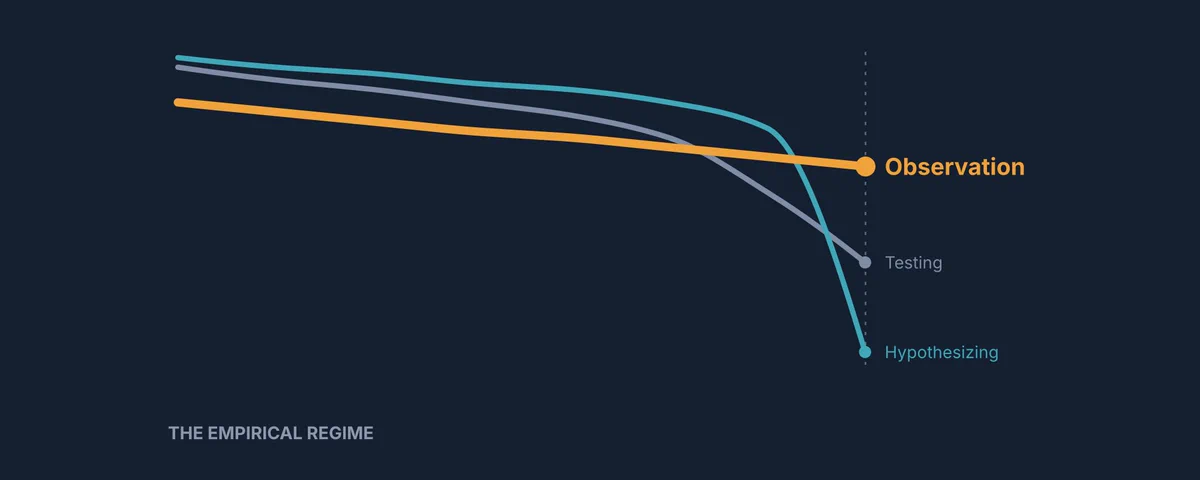
Science has always aspired to be empirical. Consider the scientific method, the underlying mechanism for progress we have relied on for centuries. We observe, hypothesize, test, observe, and repeat. All of these steps used to be expensive, but reasoning (hypothesis) was the most scarce. Frontier models have dramatically compressed the cost of hypothesizing. Compute has also made testing much cheaper, and compute, while unsolved, is a well-understood problem: build more data centers, design better chips, optimize inference. The progress loop now runs faster than ever, except for one critical step: observation.
Data is just structured observation. Data, or observation, remains poorly understood and undervalued. Those who best capture the ability to observe and turn those observations into high quality data will win. Even as testing becomes cheap, a test is only as good as what it measures against. You can only reason over what you know.
I believe data is driving two things at once: a gold rush and a changing of the world order. It is a massive short-term market and a massive long-term market. Gold rushes end, as they always do, but the change in order will not reverse.
Broadly, I see data as critical in two places:
- Advancing frontier capability of AI: LLM data, safety/alignment data, robotics or other physical AI data
- Operationalizing AI, e.g. improving agents: private data, long-horizon context management, data harnesses, inference-time data
Selling high-quality, research-forward LLM data is and will only increasingly be an extraordinarily valuable part of the data market. Data brokerages are playing an important role today as well, though most are aware that these businesses may not need venture funding, or may not need to scale very much, to be great cash-flowing businesses. Other modalities – video, audio, games, tactile – are forming their own markets. Specific domains that remain poorly modeled today, like biology and cyber/safety, may be valuable enough to command their own markets.
But the shifting role of data is far broader than model training. If you give an agent the right context and tools, you are merely saying you are giving the agent the right data; the only difference is semantics. We can be more ambitious with AI if we structure, collect, and use data in better ways. As Rieseberg suggests, something as mundane as completing a quarterly business review (QBR) can be made much more productive, given the same model, if you give the model “as much data as you can get your hands on so it can understand your business.” Private data will be important for both custom posttraining and data at inference time.
As such, I believe deployment (whether of robots or agents) will become an important form of data collection.
Data at inference time remains nascent and underdiscussed. Public data at inference time measurably improves model performance. Web data is one subset of this data. Whoever owns the means of production for real-time, diverse data will do very well.
I believe that data is yielding an entire category of companies in the same way software became an entire category of companies. Hard software problems are becoming hard data problems.
Software ate as much of the world as it could. Software is now near-infinite, and more of the world must become edible. Data makes the world edible.
Ways I Could Be Wrong
- Synthetic data: synthetic data may reduce the need for human-generated data. But synthetic data is in and of itself a hard and enduring problem. We still need high-fidelity environments, evals, and verifiers grounded in human truths.
- Generalization: If models improve in their generalizability, we may need less data. However it is against the collective economic interest of large enterprises to allow frontier models to perfectly generalize. In the interim, enterprises may avoid sharing private data and spend significantly on both building custom models and sponsoring a diverse model ecosystem. Second, generalizability does not change the need for private and inference-time data. Third, model training is a moving target as preferences change over time. Finally, if and as models generalize, wide, diverse, ongoing data will be even more critical to capturing the preferences of the broader public (and achieving alignment).
- Human service: Trust and accountability are also scarce; their scarcity may be unsolvable and (is) a prerequisite of data.