saved
Anil Seth announces the BBS collection on conscious AI and biological naturalism
Hraness cites a source capture. The source author remains the source.
Neuroscientist: consciousness, perception, & dreamachines. TED speaker, & author: Being You - A New Science of Consciousness.
1/3 Conscious AI and Biological Naturalism. A veeery loooong time in the making, but I'm happy to say that the full collection is now out in @BBSJournal 🔥 I deeply thank all commentators - of fifty commentaries! - for their wise, broad, and deep opinions on this critical topic. I also thank them for their saintly patience. 🙏🏽
I remain highly skeptical about the prospects for conscious AI (for silicon digital systems), but I've learned an enormous amount from the privilege of engaging with these commentaries. Hands down one of the most rewarding experiences of my professional life.
My hope is that - whether you agree with me or not - having such a diversity of views collected in one place will serve a useful resource for discussions about consciousness and AI.
The original target article is available here: https://www.cambridge.org/core/journals/behavioral-and-brain-sciences/article/conscious-artificial-intelligence-and-biological-naturalism/C9912A5BE9D806012E3C8B3AF612E39A
My response "The stuff matters: consciousness, computation, and biology" was published just now, and is here: https://www.cambridge.org/core/journals/behavioral-and-brain-sciences/article/stuff-matters-consciousness-computation-and-biology/E6C81A819898C25A43C7BD1F0752B1FF
And the set of 50 commentaries are collected here: https://www.cambridge.org/core/journals/behavioral-and-brain-sciences/article/conscious-artificial-intelligence-and-biological-naturalism/C9912A5BE9D806012E3C8B3AF612E39A#related-commentaries
Unfortunately these are not open access. I will try to remedy that, at least for the target & response.
FWIW there's a more accessible version of my view on the topic here in @NoemaMag https://www.noemamag.com/the-mythology-of-conscious-ai/ and also a short @TEDTalks from earlier this year https://www.ted.com/talks/anil_seth_why_ai_isn_t_going_to_become_conscious
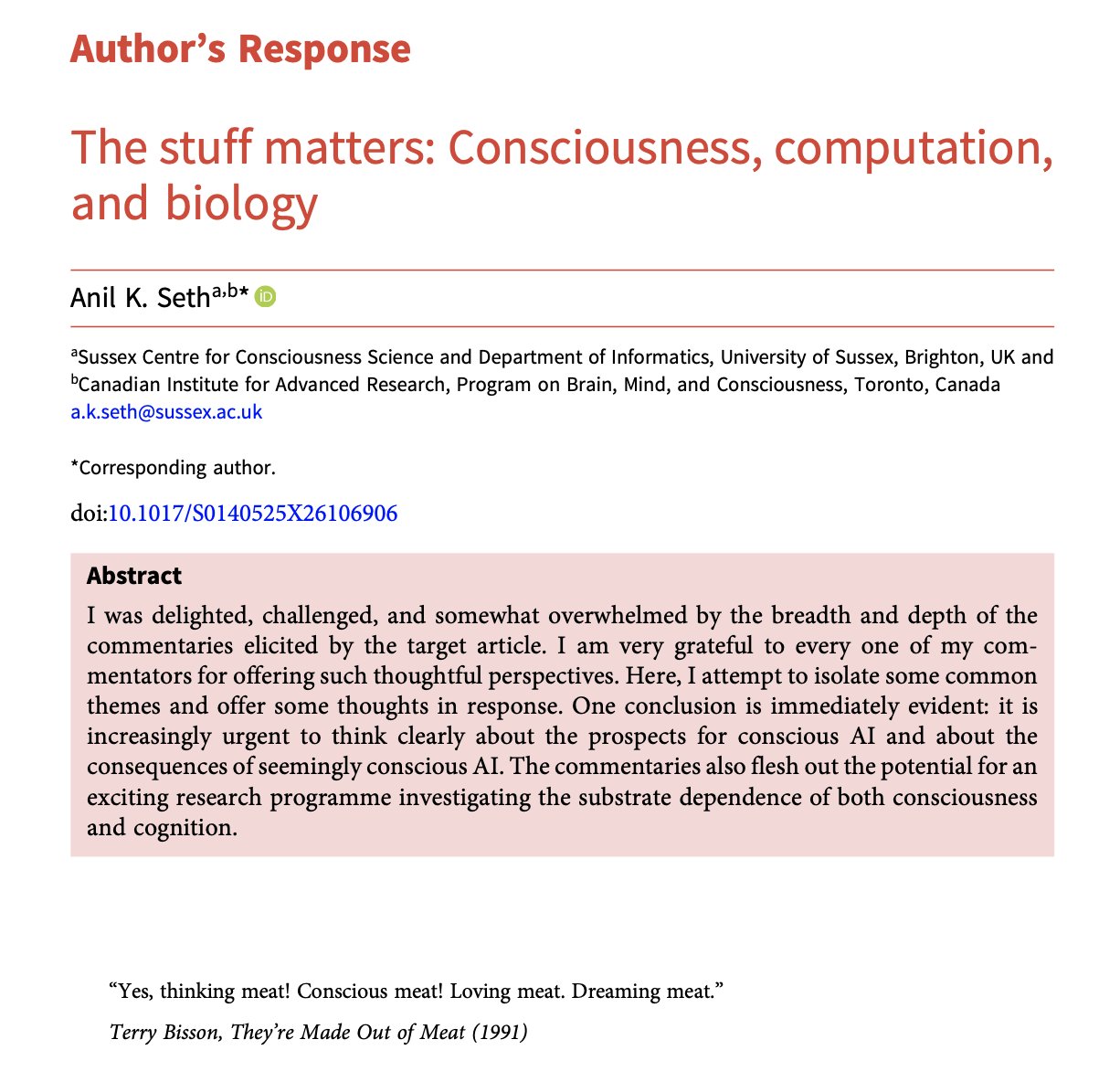
Author's Response
The stuff matters: Consciousness, computation, and biology
Anil K. Seth a,b*
a Sussex Centre for Consciousness Science and Department of Informatics, University of Sussex, Brighton, UK
b Canadian Institute for Advanced Research, Program on Brain, Mind, and Consciousness, Toronto, Canada
Email: a.k.seth@sussex.ac.uk
doi:10.1017/S0140525X25100696
Abstract
I was delighted, challenged, and somewhat overwhelmed by the breadth and depth of the commentaries elicited by the target article. I am very grateful to every one of my commentators for offering such thoughtful perspectives. Here, I attempt to isolate some common themes and offer some thoughts in response. One conclusion is immediately evident: it is increasingly urgent to think clearly about the prospects for conscious AI and about the consequences of seemingly conscious AI. The commentaries also flesh out the potential for an exciting research programme investigating the substrate dependence of both consciousness and cognition.
"Yes, thinking meat! Conscious meat! Loving meat. Dreaming meat."
Terry Bisson, They're Made Out of Meat (1991)
Behavioral and Brain Sciences
cambridge.org/bbs
Target Article
Cite this article: Seth AK. (2025) Conscious artificial intelligence and biological naturalism. Behavioral and Brain Sciences 1-21. https://doi.org/10.1017/S0140525X25000032
Target Article Accepted: 21 March 2025
Target Article Manuscript Online: 16 March 2025
Keywords: active inference; artificial intelligence; autopoiesis; biological naturalism; computational functionalism; consciousness; free energy principle; neuromorphic computation; predictive processing; substrate independence
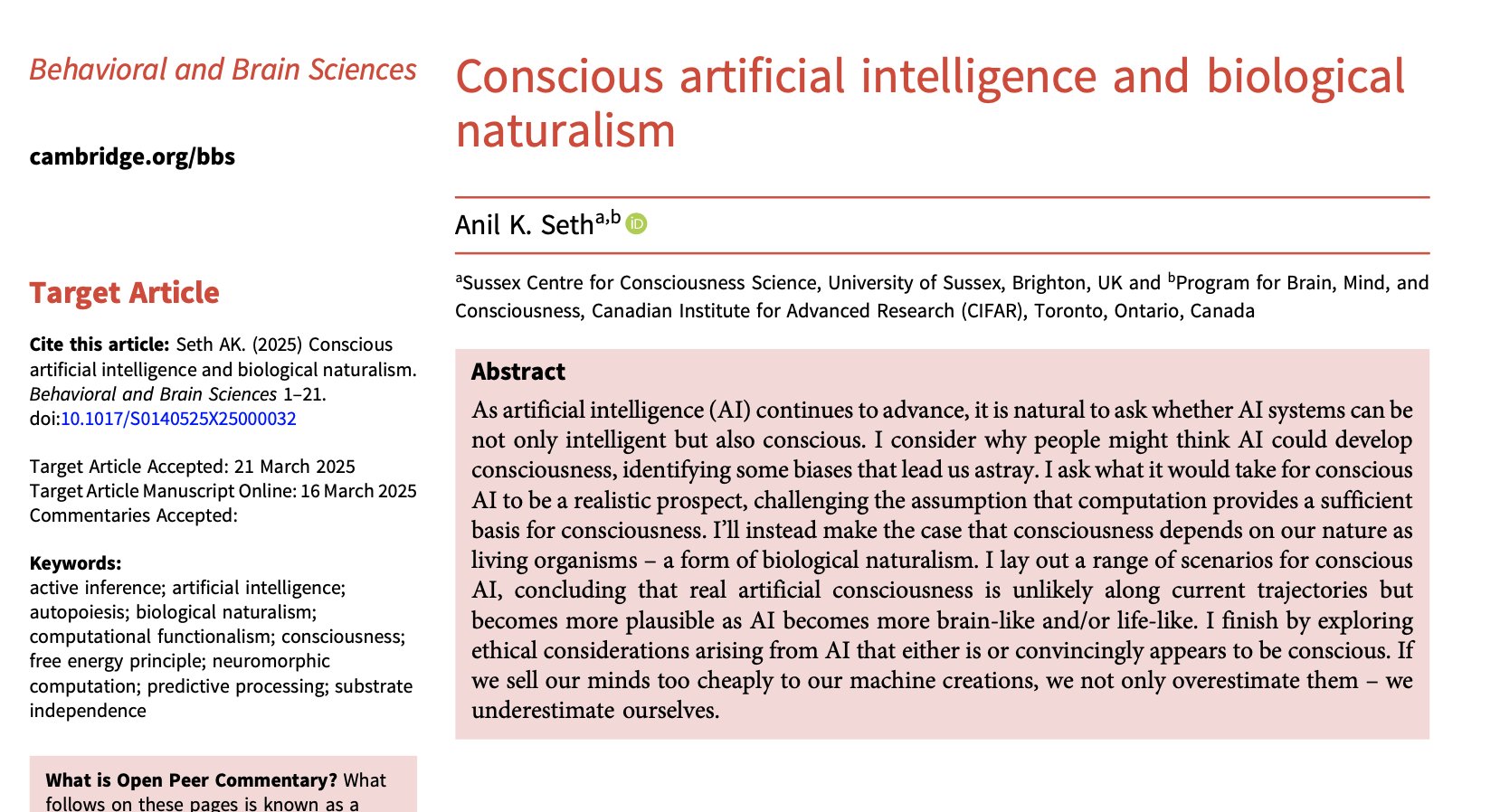
Conscious artificial intelligence and biological naturalism
Anil K. Seth a,b
a Sussex Centre for Consciousness Science, University of Sussex, Brighton, UK
b Program for Brain, Mind, and Consciousness, Canadian Institute for Advanced Research (CIFAR), Toronto, Ontario, Canada
Abstract
As artificial intelligence (AI) continues to advance, it is natural to ask whether AI systems can be not only intelligent but also conscious. I consider why people might think AI could develop consciousness, identifying some biases that lead us astray. I ask what it would take for conscious AI to be a realistic prospect, challenging the assumption that computation provides a sufficient basis for consciousness. I'll instead make the case that consciousness depends on our nature as living organisms - a form of biological naturalism. I lay out a range of scenarios for conscious AI, concluding that real artificial consciousness is unlikely along current trajectories but becomes more plausible as AI becomes more brain-like and/or life-like. I finish by exploring ethical considerations arising from AI that either is or convincingly appears to be conscious. If we sell our minds too cheaply to our machine creations, we not only overestimate them - we underestimate ourselves.