saved
AI Drug Discovery Is Becoming a Bottleneck Trade
Hraness republishes this public post from a saved copy. The post is the author’s own words.
No investment advice. https://t.co/e2Ro5VeL0o
AI Drug Discovery Is Becoming a Bottleneck Trade
I get excited when an industry starts going through a real regime change. AI drug discovery (“AIDD”) increasingly looks like one of those moments.
Two things are happening:
1/ Upstream: the frontier AI labs are piling in.
2/ Downstream: The supply chain is clearly moving.Supply-chain checks suggest the upstream picks-and-shovels of discovery and early preclinical R&D are starting to feel the increase in experimental volume.
DNA → protein → assays → sequencing → automation → preclinical testing
Names across that stack include $TWST, @GenScript, $ILMN, $TXG, lab-automation vendors and CROs.
$TWST expects triple-digit percentage growth in AI-enabled drug-discovery orders in FY26, and another year of triple-digit order growth in FY27.
@GenScript 's AIDD business doubled YoY in 1H26. Its current platform advertises industrial-scale validation of 4,000+ designs/day, with integrated sequence-to-data workflows. Our channel checks suggest the ramp is moving even faster: roughly 8,000 designs/day currently, with a path toward ~16,000/day by YE26.
Why does AI drive more wet-lab demand?
1/ AI makes hypothesis generation almost free → way more shots on goal.
The bottleneck is moving from expert-driven design to biological validation.2/ AI models need continuous experimental feedback — and both good and bad data are useful.
Traditionally, only the highest-conviction A+ candidates might get pushed into expensive validation. With AI, even the B/C candidates can be valuable because failed experiments generate training data.@GenScript has said its sequence-to-binding workflow can return data in 4–7 days, and that faster cycle times matter because AI models depend on continuous experimental feedback.
@Anthropic is a clean example. @claudeai designed 1,320 protein binders. @adaptyvbio converted those digital sequences into DNA, expressed the proteins and tested binding. Only 354 actually bound. And the 966 failures are not wasted. They are useful negative labels: what does not express, what does not bind, what has poor affinity. Those results help train the next model iteration.
3/ Wet labs are no longer just making drugs. They are making training data.
$TWST / @GenScript increasingly look like biological data foundries.$TWST explicitly talks about generating model-ready data from AI-designed sequences. In some workflows, the customer may care less about receiving the physical protein than about getting structured experimental results back into the model.
Traditional drug discovery asks: “Does candidate X work?”
AI drug discovery also asks: “What can this experiment teach the model?”
TAM of AIDD
If AI is simply a better R&D tool, the relevant spending pool is the $300–400B of annual global pharma R&D. If AI meaningfully increases the number of viable drug programs, the opportunity is larger because it expands downstream demand for DNA synthesis, protein production, assays, and preclinical work.
Near term, we can also size demand from AI-company spending. If Anthropic reaches $80B of ARR in 2026 and spends just 1% on AIDD, that alone would imply ~$800M of annual investment.
Trade setup
This is a trade that could have long legs. It’s hard to really stop working until PhaseI/II results (2028+)
It smells a lot like the bottleneck trade we just saw in semis: GPUs → HBM → networking → power/cooling. In biology, It basically follows the drug discovery process downstream: AI models → designs → DNA/protein → assays → preclinical capacity.
After the upstream picks-and-shovels, animal testing could become the next bottleneck. Monkey prices are already near prior highs and CRO capacity is tight. AIDD pushing more candidates into preclinical development would only add demand.
?? But clinical trials are still the bottleneck?
This is the biggest pushback I keep coming back to. No matter how fast discovery becomes, drugs still need to go through preclinical → Phase I → Phase II → Phase III → approval. You still need patients, time and capital.But that doesn’t mean the bottleneck trade won’t work. More viable candidates — especially with higher success rates — still means more demand throughout the development process.
And who knows: clinical trials themselves may eventually be optimized by AI.
?? What breaks the trade?
Near term, the picks-and-shovels trade breaks if experimental budgets stop growing, AI-generated designs don’t translate into useful wet-lab hits, or capacity catches up too quickly.Longer term, the thesis breaks if AI drugs look great in discovery / Phase I but fail at normal rates in Phase II/III. That is why Phase II matters so much.
?? Milestones
Late 2026–2027: first Isomorphic-designed drugs enter human trials; more AI-native programs move into IND-enabling work / tox.2028–2030: clinical trial results start telling us whether AI-designed drugs actually perform better than conventional drugs.
Calling all the "bottleneck bros".:) @jukan05 @zephyr_z9 @aleabitoreddit @ParadisLabs
+++
More comprehensive analysis: robonomics.substack.com/p/ai-drug-disc…Image 1
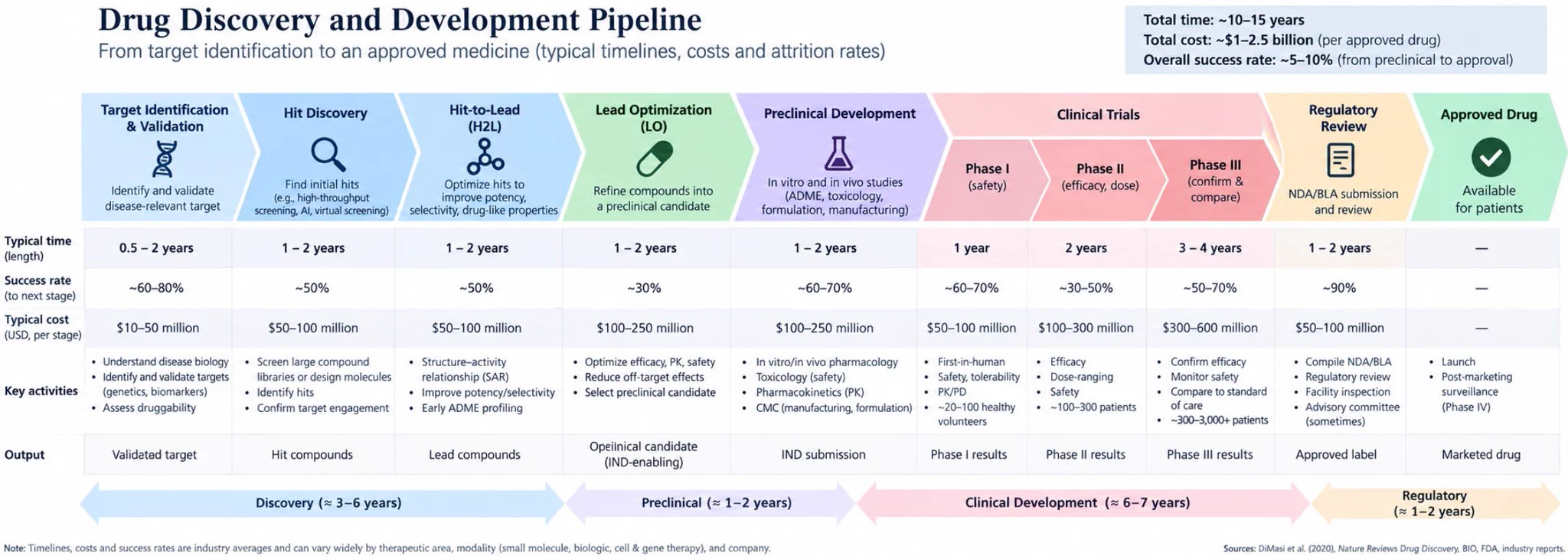
Drug Discovery and Development Pipeline
From target identification to an approved medicine (typical timelines, costs and attrition rates)
Total time: ~10–15 years
Total cost: ~$1–2.5 billion (per approved drug)
Overall success rate: ~5–10% (from preclinical to approval)
- Target Identification & Validation: Identify and validate disease-relevant target. Typical time (length): 0.5 – 2 years. Success rate (to next stage): ~60–80%. Typical cost (USD, per stage): $10–50 million. Key activities: Understand disease biology; Identify and validate targets (genetics, biomarkers); Assess druggability. Output: Validated target.
- Hit Discovery: Find initial hits (e.g., high-throughput screening, AI, virtual screening). Typical time (length): 1 – 2 years. Success rate (to next stage): ~50%. Typical cost (USD, per stage): $50–100 million. Key activities: Screen large compound libraries or design molecules; Identify hits; Confirm target engagement. Output: Hit compounds.
- Hit-to-Lead (H2L): Optimize hits to improve potency, selectivity, drug-like properties. Typical time (length): 1 – 2 years. Success rate (to next stage): ~50%. Typical cost (USD, per stage): $50–100 million. Key activities: Structure–activity relationship (SAR); Improve potency/selectivity; Early ADME profiling. Output: Lead compounds.
- Lead Optimization (LO): Refine compounds into a preclinical candidate. Typical time (length): 1 – 2 years. Success rate (to next stage): ~30%. Typical cost (USD, per stage): $100–250 million. Key activities: Optimize efficacy, PK, safety; Reduce off-target effects; Select preclinical candidate. Output: Opeiinical candidate (IND-enabling).
- Preclinical Development: In vitro and in vivo studies (ADME, toxicology, formulation, manufacturing). Typical time (length): 1 – 2 years. Success rate (to next stage): ~60–70%. Typical cost (USD, per stage): $100–250 million. Key activities: In vitro/in vivo pharmacology; Toxicology (safety); Pharmacokinetics (PK); CMC (manufacturing, formulation). Output: IND submission.
- Clinical Trials, Phase I (safety): Typical time (length): 1 year. Success rate (to next stage): ~60–70%. Typical cost (USD, per stage): $50–100 million. Key activities: First-in-human; Safety, tolerability; PK/PD; ~20–100 healthy volunteers. Output: Phase I results.
- Clinical Trials, Phase II (efficacy, dose): Typical time (length): 2 years. Success rate (to next stage): ~30–50%. Typical cost (USD, per stage): $100–300 million. Key activities: Efficacy; Dose-ranging; Safety; ~100–300 patients. Output: Phase II results.
- Clinical Trials, Phase III (confirm & compare): Typical time (length): 3 – 4 years. Success rate (to next stage): ~50–70%. Typical cost (USD, per stage): $300–600 million. Key activities: Confirm efficacy; Monitor safety; Compare to standard of care; ~300–3,000+ patients. Output: Phase III results.
- Regulatory Review: NDA/BLA submission and review. Typical time (length): 1 – 2 years. Success rate (to next stage): ~90%. Typical cost (USD, per stage): $50–100 million. Key activities: Compile NDA/BLA; Regulatory review; Facility inspection; Advisory committee (sometimes). Output: Approved label.
- Approved Drug: Available for patients. Typical time (length): —. Success rate (to next stage): —. Typical cost (USD, per stage): —. Key activities: Launch; Post-marketing surveillance (Phase IV). Output: Marketed drug.
Discovery (≈ 3–6 years) · Preclinical (≈ 1–2 years) · Clinical Development (≈ 6–7 years) · Regulatory (≈ 1–2 years)
Note: Timelines, costs and success rates are industry averages and can vary widely by therapeutic area, modality (small molecule, biologic, cell & gene therapy), and company.
Sources: DiMasi et al. (2020), Nature Reviews Drug Discovery, BIO, FDA, industry reports.
Image 2
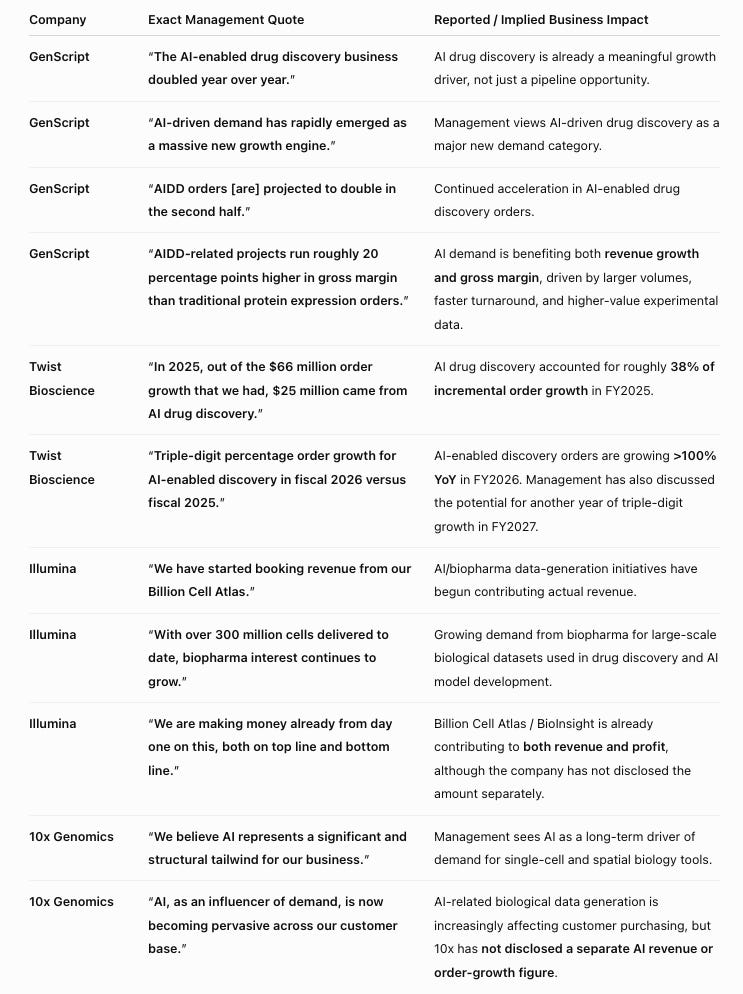
Company | Exact Management Quote | Reported / Implied Business Impact
- GenScript | “The AI-enabled drug discovery business doubled year over year.” | AI drug discovery is already a meaningful growth driver, not just a pipeline opportunity.
- GenScript | “AI-driven demand has rapidly emerged as a massive new growth engine.” | Management views AI-driven drug discovery as a major new demand category.
- GenScript | “AIDD orders [are] projected to double in the second half.” | Continued acceleration in AI-enabled drug discovery orders.
- GenScript | “AIDD-related projects run roughly 20 percentage points higher in gross margin than traditional protein expression orders.” | AI demand is benefiting both revenue growth and gross margin, driven by larger volumes, faster turnaround, and higher-value experimental data.
- Twist Bioscience | “In 2025, out of the $66 million order growth that we had, $25 million came from AI drug discovery.” | AI drug discovery accounted for roughly 38% of incremental order growth in FY2025.
- Twist Bioscience | “Triple-digit percentage order growth for AI-enabled discovery in fiscal 2026 versus fiscal 2025.” | AI-enabled discovery orders are growing >100% YoY in FY2026. Management has also discussed the potential for another year of triple-digit growth in FY2027.
- Illumina | “We have started booking revenue from our Billion Cell Atlas.” | AI/biopharma data-generation initiatives have begun contributing actual revenue.
- Illumina | “With over 300 million cells delivered to date, biopharma interest continues to grow.” | Growing demand from biopharma for large-scale biological datasets used in drug discovery and AI model development.
- Illumina | “We are making money already from day one on this, both on top line and bottom line.” | Billion Cell Atlas / BioInsight is already contributing to both revenue and profit, although the company has not disclosed the amount separately.
- 10x Genomics | “We believe AI represents a significant and structural tailwind for our business.” | Management sees AI as a long-term driver of demand for single-cell and spatial biology tools.
- 10x Genomics | “AI, as an influencer of demand, is now becoming pervasive across our customer base.” | AI-related biological data generation is increasingly affecting customer purchasing, but 10x has not disclosed a separate AI revenue or order-growth figure.