saved
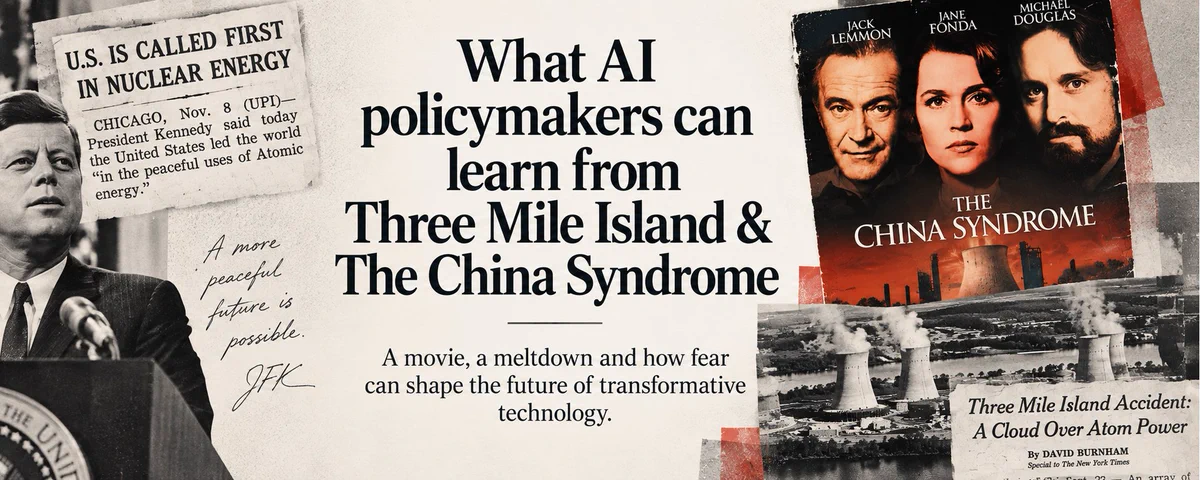
A movie, a meltdown and how fear can change the future of transformative technology
Hraness cites a source capture. The source author remains the source.
inception stage VC in technical teams. @huggingface @factoryai @modal @patronusai @whitecircle …more at https://t.co/yuMjrW6XUl 🎹piano player @sidgoldsreqroom.
What AI Policymakers can learn form Three Mile Island and The China Syndrome
A movie, a meltdown and how fear can change the future of transformative technology
Much of the policy analogies around AI risk are around Nuclear Weapons, but it’s worth revisiting the debate around Nuclear Energy.
If you're my age, you've sort of vaguely heard of Three Mile Island as some kind of nuclear meltdown, and it was. But you might be surprised to learn that not a single person killed or seriously injured. Yet it became a symbol of the risks of nuclear energy.
A strange confluence of events have got me thinking about Three Mile Island. As the first investor in @Huggingface (they started out of my office at @betaworks 7 years before ChatGPT came out ), I’ve had a front-row seat to the open-source AI movement and paid close attention to the hack earlier this year and the following policy implications. Coincidentally, my dad worked for the Governor of Pennsylvania during Three Mile Island, the largest nuclear meltdown in the US, which happened in Pennsylvania.
So I’ve been fascinated at the parallels between the promise and risks of AI and what we can learn from policy around Nuclear Energy after the 1979 meltdown.
Twelve days before Three Mile Island occurred, a fictional movie came out called The China Syndrome. This was the timeline in 1979:
- March 15: Journalists say Hollywood's fictional nuclear accident may have major political consequences.
- March 16: Movie opens.
- March 28: A real nuclear reactor partially melts down at Three Mile Island
- March 30: Newspapers are explicitly interpreting reality through the movie.
- April: Nuclear policy becomes a major national political issue.
From @TIME in April 1979: "The premise [is] a nuclear power plant is not nearly as accident-proof as its builders proclaim and that “the China Syndrome,” a total meltdown that causes the core to sink lethally into the earth (hence, fancifully, toward China)...ironically, given the bias of the film makers, what actually happened at Three Mile Island is far more serious than the “event” portrayed at the fictional plant. The stock market indicated the public’s response. Shares of Columbia Pictures, which gained a publicity bonanza for its movie, soared by $2.74 in two days, to $24.75. Stocks of nuclear power companies declined sharply."
What's notable here, and relevant to those of us following AI policymaking closely, is that the movie and the real life events were merged in the minds of Americans. I was certainly surprised to learn that there were no deaths or major injuries from Three Mile Island, despite it being the poster-child for the (lack of) safety of Nuclear Energy.
This is especially notable as history repeats itself with new movies coming out portraying tech leaders as evil in the midst of AI hacks and fears of worse.
Contemporaneous @nytimes from 1979 and the years following it is informative to what the debate felt like the months and early years after the meltdown:
- "A national disenchantment with nuclear power had been growing for several years, dimming the once-great expectations of a technological marvel held to be capable of generating an endless supply of cheap energy.
- "Environmentalists Criticize Carter on Nuclear Policy -- Five national environmental organizations have joined in sharply criticizing the recent direction of President Carter's policies on the commercial development of nuclear power."
- "The accident at the Three Mile Island nuclear reactor has yielded at least one insight to which most people might agree; When it comes to assessing risk, the eye of the beholder is as important as any "objective" ranking of dangers. When it comes to formulating energy policy, it may be more important."
- "No one was killed or palpably hurt...yet people seem to fear imagined horror and the unknown far more the greater, verified risk tof the familiar. Cigarette smoking, for example, is an incomparably greater public health hazard than snakes. Still, snakes inspire dread never achieved by antismoking campaigns. So planners are stuck...Some experts will argue that nuclear energy already is less risky to life than coil, oil, solar or wind energy...But those plotting our energy future must deal with the expertss' loss of credibility, with a public that no longer automatically believes scientific assessments of nuclear risk. "
In 1961, President Kennedy declared that the US would become first in nuclear energy. But between 1979 and 2012 the US issued no new construction permits for new plants.
The road not taken
The cost to the US not pursuing nuclear energy is hard to measure because it is the road not taken, but France did take a path that illustrates the opportunity cost over that 30 year period.
France responded to the 1970s energy crisis by building nuclear plants rather than retreating from them. Today about two thirds of its electricity comes from nuclear power versus 18% in the US, giving France one of the least carbon-intensive electrical grids in the world and generates so much electricity that in 2024 France exported a record net 89 TWh, and then broke its own record again in 2025 with 92.3 TWh.
The countries which invested in nuclear energy are also unusually insulated from the commodity-price shocks that cause inflation elsewhere in the economy. The Iran war and disruption of the Strait of Hormuz is only the most recent such example of oil and natural gas prices spiking. These types of energy shocks don’t just show up in our electric bills, they show up in manufacturing costs, transportation, fertilizer, food, all contributing to inflation we all feel.
There were real risks with Nuclear Energy. The disaster at Chernobyl ultimately caused thousands of deaths and was due to faulty design. There are also real risks to developing AI without guardrails today.
So how might this inform AI policy today?
The Overton window on today’s debate around AI spans from @BernieSanders and @RepCasar (who happens to be my congressional representative) advocating for a permanent ban on “superintelligence” and a pause on all AI development; the other extreme is that we need to beat China in the AI race at all costs.
Those are extremes, whereas it's heartening to see @davidsacks and @linamkhan essentially agree that liability (and application of our existing laws) would have the second order effect of pacing. To paraphrase @ClementDelangue: the reason people don't shoplift isn't because it's hard, it's because they believe it's wrong or know it's illegal. The capabilities of the model companies shouldn't dictate whether or not they do a thing.
The Huggingface hack by @OpenAI is not good, and we have laws which define consequences for hacking other companies. Liability-wise, this a particularly interesting instance because it wasn’t a third party using OpenAI to hack, it was OpenAI using its own model itself which ultimately did the hacking. If they perceived there would be consequences to doing this, one could imagine the company taking more precautions during its research.
But lost in the headlines is that some guardrails are actually working already. Huggingface tried to use @Anthropic ’s AI’s models to help it defend itself. However Anthropic’s model refused to participate because it could tell that it was being used in relation to a hack and had guardrails against hacking. Now, obviously it got things wrong, it should have helped defensively, but noteworthy that the guardrails actually worked and if anything were too narrow.
Not Just Deflationary, Revolutionary
In the Nuclear era, the fictionalized danger ended up shaping real public policy. I’d argue it wasn’t without cost to the environment, to the economy, and ultimately to the price of eggs.
Additionally, it’s hard to argue that we’d be better off if the luddites had smashed all of the factories. We would be without access to baby formula, without the ability to transport it across the country, without the ability to manufacture drug vaccines at scale, and without the ability to visit friends and family cheaply across the country in mere hours.
AI’s promise isn’t just that it could be a deflationary pressure like nuclear power, although it likely will be. The promise is that it will bring the cost of developing orphan drugs down to near zero; it will be able to better detect diseases in both the young and the old; it has already helped us solve previously intractable math problems.
While the fears are science fiction, the positive realities are already here.
In Australia, a man used ChatGPT and AlphaFold (an AI that analyzes proteins) to produce an RNA vaccine that reduced his dog’s tumor by 50%, regrowing its hair, in the midst of a diagnosis that the dog had three months to live. The AI surpassed his human intelligence.
Huggingface is currently conducting a hackathon called Rare Disease, Real Kid, to help people living with Mosaic Variegated Aneuploidy (MVA), an ultra-rare genetic condition affecting fewer than 50 people worldwide. There is currently no established treatment and the family of an affected child opened up the clinical symptoms and genomic data to have researchers use AI for variant prediction and drug repurposing.
As @neuralink begins to get signals from the brains of patients who are completely immobilized from ALS, it will be AI which processes those signals into commands to help them interact with the world.
It is almost uncanny to notice that the Three Mile Island and The China Syndrome happened in tandem, and that in the same year of the Huggingface hack, there are two movies about to be released about AI industry leaders @sama and @elonmusk.
In this moment of heightened fear, let’s not lose sight of AI’s revolutionary capabilities. Let’s not have the 30 year nuclear winter of American Artificial Intelligence.
Cover collage headline: What AI policymakers can learn from Three Mile Island & The China Syndrome. Sub-headline: A movie, a meltdown and how fear can shape the future of transformative technology. Left: black-and-white photo of John F. Kennedy at a podium; newspaper clipping headline U.S. IS CALLED FIRST IN NUCLEAR ENERGY; body CHICAGO, Nov. 8 (UPI)—President Kennedy said today the United States led the world "in the peaceful uses of Atomic energy."; handwritten note A more peaceful future is possible. JFK. Right: THE CHINA SYNDROME movie poster naming JACK LEMMON, JANE FONDA, and MICHAEL DOUGLAS above a nuclear plant illustration; photo of cooling towers; New York Times clipping headline Three Mile Island Accident: A Cloud Over Atom Power; byline By DAVID BURNHAM Special to The New York Times.